
What is Liquid Staking? Complete Guide for 2026
Liquid staking lets you earn staking rewards while keeping your assets usable. This guide explains how it works, compares major Solana LSTs, and helps you decide which approach fits your goals.
TL;DR. Liquid staking on Solana lets you earn protocol rewards while holding a transferable receipt token (raSOL, JitoSOL, mSOL, JupSOL, bpSOL). The token count stays fixed; the SOL redemption rate appreciates each epoch as underlying stake earns. APYs cluster at 5 to 7%, with the spread driven by MEV, fees, and validator selection. Choose native staking for the cleanest custody, liquid staking for composability.
You want to stake your SOL to earn yield. But traditional staking locks your assets for days - and if an opportunity comes up, you're stuck.
Liquid staking solves this. You earn staking rewards and keep your assets usable. But here's what most guides won't tell you: not all liquid staking tokens are the same, and the differences matter more than you think.
This guide explains how liquid staking actually works, compares the major Solana LSTs with real data, and helps you decide which approach fits your goals.
How liquid staking works
When you liquid stake, three things happen:
- You deposit SOL into a liquid staking protocol
- The protocol stakes it to validators and gives you a liquid staking token (LST)
- Your LST appreciates in value as staking rewards accrue
Your LST is a receipt for staked SOL. It's not pegged 1:1 forever - it grows relative to SOL over time.
Example: If you deposit 100 SOL today and receive 100 mSOL, in a year that 100 mSOL might be redeemable for ~106 SOL (at current ~6% APY). The mSOL quantity stays the same; its SOL-value increases.
This is called a reward-bearing token - no claiming, no rebasing, just automatic appreciation.
Where liquid staking fits next to native staking
The short version: native staking gives the cleanest custody and a slightly higher net APY because there is no protocol fee, while liquid staking trades a little yield for a transferable token you can exit instantly and use across DeFi. If you are weighing the two, we cover the full head-to-head - custody, APY, liquidity, risk, and taxes - in native vs liquid staking on Solana. The rest of this guide focuses on liquid staking itself.
Solana liquid staking protocols 2026 compared
The major Solana liquid staking protocols in 2026 and what actually distinguishes each one:
| Token | Protocol | What makes it distinct |
|---|---|---|
| JitoSOL | Jito | Modified validator client captures MEV; share routes to holders |
| mSOL | Marinade | Stake Auction Marketplace lets validators bid for stake; oldest Solana LST, SOC 2 certified |
| INF | Sanctum | Index across many LSTs rather than a single staking position; infrastructure-level exposure |
| JupSOL | Jupiter | Compounded yield routed through Jupiter's DEX aggregator |
| bpSOL | Backpack | LST native to the Backpack wallet and exchange |
| raSOL | Hubra | Single validator backing (Hubra, operating since 2020) running the Jito client; MEV flows through to stakers alongside base staking rewards |
All Solana LST APYs cluster in the 5 to 7% band; the spread comes from the mechanisms in the next section. For live numbers, see Sanctum.
For a focused head-to-head of the three that matter most for SOL holders, see the best Solana liquid staking token in 2026: raSOL vs JitoSOL vs mSOL.
Why the APY differences?
The ~0.5% spread between LSTs isn't random. It comes from:
1. MEV Distribution (Jito) Jito runs modified validator software that captures MEV (Maximal Extractable Value) - essentially, profits from transaction ordering. JitoSOL holders get a share of this. When on-chain activity is high, Jito's effective APY can spike above competitors.
2. Stake Auction Marketplace (Marinade) Marinade's SAM lets validators bid for stake. Higher-performing validators pay more to receive delegations, and that premium flows to mSOL holders. It's a market mechanism that theoretically optimizes for the best validators.
3. Protocol Fees Each protocol takes a cut (typically 5-10% of staking rewards). Lower fees = higher APY for you, but also less protocol revenue for development.
4. Validator Selection How a protocol picks validators affects returns. Some optimize purely for APY; others balance decentralization, uptime, and commission rates.
The Sanctum layer
Here's something most liquid staking guides miss: Sanctum is the infrastructure layer that connects all Solana LSTs.
What this means practically:
- You can swap between LSTs instantly (mSOL → JitoSOL → raSOL) with minimal slippage
- New LSTs get instant liquidity by plugging into Sanctum's unified pool
- No fragmented liquidity - the old problem of "I have mSOL but the opportunity needs JitoSOL" is solved
This is why raSOL, despite being newer, has full liquidity from day one - it's built on Sanctum's infrastructure.
Which LST should you choose?
This is a low-stakes choice: because all the major tokens settle through Sanctum's shared liquidity, you can move between them in one transaction as your priorities change. In brief, JitoSOL leads on liquidity depth and DeFi integrations, mSOL on validator decentralization and holder base, and raSOL pairs a single validator running since 2020 with Jito MEV pass-through and instant exit. For the full head-to-head - APY, MEV, liquidity, and decentralization side by side - see the best Solana liquid staking token in 2026: raSOL vs JitoSOL vs mSOL.
If you stake through a platform like Hubra, the specific LST matters less - you hold a liquid position and the platform handles validator selection, restaking, and rewards. What matters most is staying liquid and non-custodial.
Liquid staking strategy tips for 2026
A few practical rules that hold up regardless of which LST you pick:
- Don't chase the top APY blindly. The spread between LSTs is ~0.5%. A protocol advertising a much higher number is usually adding risk (leverage, points speculation, or a thin liquidity pool) to get there.
- Stay where exit liquidity is deep. Your real yield includes the cost to leave. An LST with shallow pools can cost more in slippage on exit than it ever paid you in extra APY. Check instant unstake depth before you size up.
- Match the LST to the use. Holding for yield only? Almost any audited LST works. Using it as DeFi collateral? Pick one with the integrations you need (Kamino, Jupiter, Orca).
- Don't fragment across five protocols. Each one is a separate smart-contract risk surface and a separate tax lot. One or two is plenty for most holders.
- Re-check minimums. Since the 1 SOL native minimum landed, liquid staking is now the cleanest route for balances under 1 SOL, because pooled staking is not bound by that floor.
Is liquid staking on Solana safe in 2026?
Liquid staking is mature on Solana in 2026, but "safe" is relative. Your staked SOL principal is delegated to validators, not held by the protocol, so it does not vanish through normal operation. The real risks are below - know them before you deposit.
Smart contract risk
Every LST relies on smart contracts. If there's a bug or exploit, staked funds could be at risk. Mitigation: stick to audited, high-TVL protocols.
Depeg risk
In extreme market conditions, LSTs can trade below their "fair" SOL value. This happened briefly with stETH on Ethereum during the 2022 market crash. On Solana, Sanctum's unified liquidity layer reduces this risk significantly - but it's not zero.
Validator slashing
Solana doesn't currently have slashing (validators losing stake for misbehavior), but this could change. If implemented, liquid staking protocols would need to handle slashing events.
Opportunity cost
At 5 to 7% APY, liquid staking is solid but not spectacular. In a bull market with high DeFi yields, you might find better risk-adjusted returns elsewhere. The advantage is that with an LST, you can also pursue those opportunities (e.g., deposit your mSOL as collateral on Kamino).
How to start
The manual way (multiple apps)
- Go to jito.network, marinade.finance, or sanctum.so
- Connect wallet
- Deposit SOL, receive LST
- If you want to use it in DeFi, go to Kamino/jupiter separately
- Manage positions across multiple dashboards
The Hubra way (focused on staking)
- Open hubra.app
- Connect wallet
- Stake SOL → receive raSOL (or stake USDC for stablecoin yield)
- Yield compounds in the background, your keys stay yours
The difference: Hubra is built for staking specifically. SOL and USDC, non-custodial, with the polish people expect from traditional finance - no validator selection, no protocol shopping, no separate dashboards.
Bottom line
In 2026, leaving your SOL un-staked means missing 5 to 7% annual yield. With liquid staking, you get that yield without giving up flexibility.
The question isn't whether to liquid stake - it's which approach fits your needs:
- Maximizing raw yield? Compare JitoSOL vs mSOL APYs and pick the leader
- Want a calm, non-custodial home for SOL (and USDC)? Stake on Hubra
- Building a DeFi strategy? Pick an LST with deep integrations (Kamino, Jupiter, etc.)
Whatever you choose, you'll be earning yield while keeping your assets productive. That's the point.
Ready to start? Explore liquid staking on Hubra →
Last updated: June 2026
APY data sourced from Sanctum. Rates fluctuate - always verify current yields before depositing.
 Education
What You Can Do With raSOL in Solana DeFi
Your staked SOL does not have to sit still. Five ways to put raSOL to work across Solana DeFi, from Kamino loops to Meteora liquidity, and the risks of each.
 Education
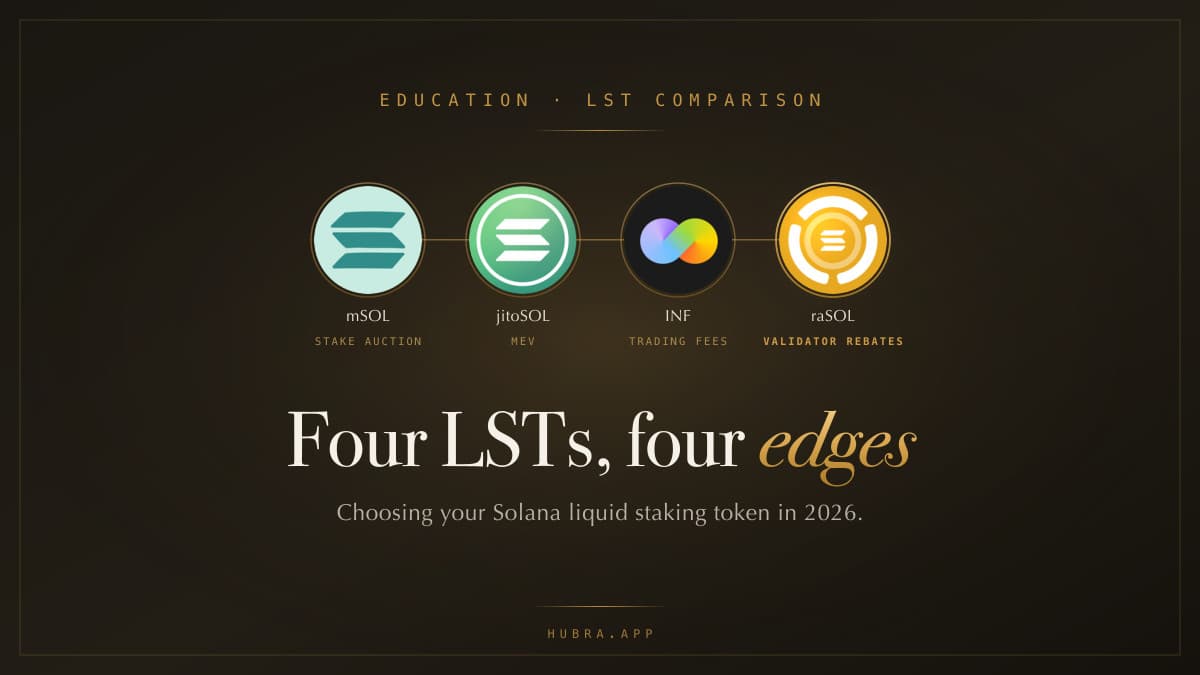
raSOL vs JitoSOL vs mSOL vs INF: Solana LST Compared
JitoSOL leads on liquidity, mSOL on its validator stake auction, INF on diversified fee-boosted yield, and raSOL rebates the earnings of a single long-running validator, with instant exit. Here is how the major Solana LSTs compare in 2026.
 Education
How to Stake SOL in 2026: A Complete, Practical Guide
A plain-English walkthrough of how to stake SOL in 2026: the two main routes, how to pick a validator, what APY to expect, how to exit, and the risks worth knowing, written plainly.