
From Delegation to Markets: Our Next Step in Solana Staking with Pye
Staking is one of the safest and most common ways Solana users earn on their SOL. But for all its importance, staking has remained surprisingly rigid. That's why Hubra is collaborating with Pye on programmable staking markets.
TL;DR. Hubra is collaborating with Pye on programmable staking markets for Solana. A staking position splits into a Principal Token (PT) representing the underlying staked SOL and a Reward Token (RT) representing future rewards, enabling tradable structure without breaking the validator relationship. Hubra is participating in Pye's early beta to help shape the design before it scales.
Staking is one of the safest and most common ways Solana users earn on their SOL. But for all its importance, staking has remained surprisingly rigid.
Today, stakers are forced into a narrow set of choices: lock up capital for a fixed period, accept a single reward stream, and give up flexibility in exchange for yield. If you want liquidity, optionality, or more control over risk and duration, your choices are limited. This often pushes users toward more complex DeFi strategies with higher operational and smart-contract risk.
We believe staking should offer more options without asking users to take on more risk.
That belief is what led Hubra to collaborate with Pye on the early development of programmable staking markets on Solana.
Our Goal
Our goal is to give stakers more control over how their capital is used, whether that means choosing duration more precisely, separating principal from rewards, or accessing yield in ways that better match individual risk preferences.
Pye is building a framework that allows stake accounts to become programmable and, over time, tradable, without breaking the core validator relationship that secures the network. Instead of forcing users to choose between security and flexibility, programmable staking introduces a way to structure staking positions more intentionally, while remaining within the validator ecosystem.
As part of this collaboration, Hubra is participating in Pye's early beta to help shape how staking and reward markets should work before they scale, with the end user in mind.
How Programmable Staking Works
Traditional staking treats stake as a single, illiquid position - the classic native vs liquid staking trade-off. Pye introduces a model where staking lockups can be expressed more flexibly.
Under this framework, a staking position can be separated into two components:
- Principal Token (PT): representing the underlying staked SOL and its lockup
- Reward Token (RT): representing future staking rewards generated over time
This separation creates the foundation for new use cases, including the ability to manage future rewards more intentionally and layer additional economic components without breaking the validator relationship.
Importantly, these mechanics are designed to operate within the validator ecosystem, not outside of it.
Why We're Participating Early
Our participation at this stage is not about short-term volume or liquidity. It's about helping shape how staking markets should function responsibly.
We're interested in:
- Helping define the future of Solana protocol economics
- Running pilots and playing an active role in the design of stake trading microstructure
- Exploring new, aligned revenue models for validators
As staking matures, we believe markets built deliberately will outperform those rushed into existence.
What Comes Next
Pye is still in beta, with markets forming deliberately before trading functionality is introduced. Trading functionality will come later, once foundations are in place.
We're excited to contribute feedback, participate in early markets, and help define what the next phase of staking on Solana looks like.
About Pye
Pye is building a Solana-native platform centered on programmable stake accounts (PSAs), a new staking primitive designed to support stake trading and more flexible staking structures over time. This approach allows stake accounts to move beyond static delegation and become composable across the Solana ecosystem as markets form.
Learn more:
 Editorial
From super-app to staking specialist
The most important word in product strategy is no. After building toward a multi-product DeFi super-app, we're focusing on a single experience: staking, done with the discipline serious holders deserve.
 Education
What You Can Do With raSOL in Solana DeFi
Your staked SOL does not have to sit still. Five ways to put raSOL to work across Solana DeFi, from Kamino loops to Meteora liquidity, and the risks of each.
 Education
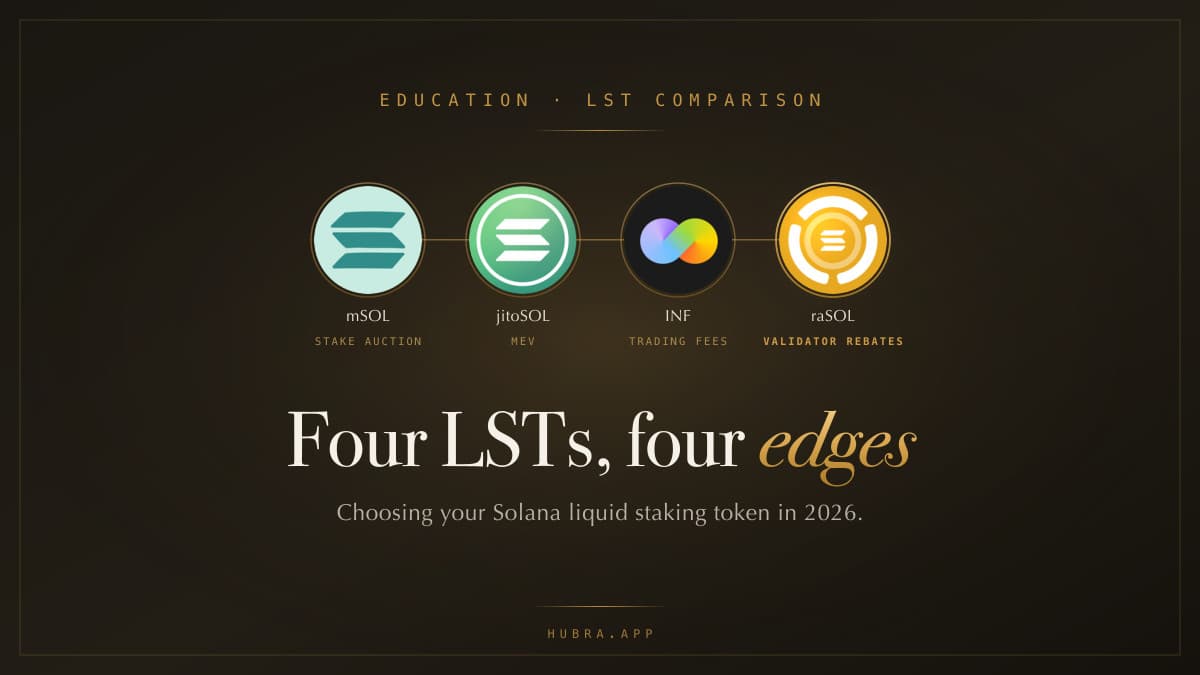
raSOL vs JitoSOL vs mSOL vs INF: Solana LST Compared
JitoSOL leads on liquidity, mSOL on its validator stake auction, INF on diversified fee-boosted yield, and raSOL rebates the earnings of a single long-running validator, with instant exit. Here is how the major Solana LSTs compare in 2026.