
Alpenglow: Solana's new consensus, in plain English
Alpenglow is the biggest change to Solana since the chain went live. Confirmations that feel instant, a calmer chain under the hood, and a new validator fee called the VAT that's designed to keep economics flat, not to raise your staking yield. Here's what it means in plain English.
TL;DR. Alpenglow is the biggest change to Solana since the chain launched. It makes confirmations feel instant (about 150 milliseconds instead of 12 to 13 seconds) and reorganizes how validators pay to participate. It does not raise staking APY. The proposal is intentionally designed to keep validator and staker economics flat. The wins are speed and reliability, not yield.
If you hold SOL, stake on Hubra, or just use Solana apps, Alpenglow is the upgrade you'll feel. This post explains what's actually changing, what it means for you, and what the team behind it is being honest about.
The one-paragraph version
Solana's "consensus" is the part of the chain that decides which transactions are real and in what order. Today that system is several years old. Alpenglow replaces the two oldest pieces of it with newer designs called Votor (the voting part) and Rotor (the part that ships blocks around the network). The result: transactions go from "confirmed in about 12 seconds" to "confirmed in about 150 milliseconds." Validators stop paying tiny fees for every vote, and instead pay one flat fee per epoch (called the VAT) which gets burned. Most other things, including how staking works for you, stay the same.
What "finality" means, and why 150 ms is a big deal
When you send a Solana transaction today, it usually shows up in a wallet as confirmed within a second or two. But the chain doesn't consider that transaction truly final until enough validators have agreed on it. That moment, called finality, takes about 12 to 13 seconds today.
Most of the time you don't notice. But for things that need to be sure, like an exchange crediting a deposit, a payment terminal at a coffee shop, or a price oracle, those 12 seconds matter. They force apps to wait, or to assume the transaction will hold and quietly handle the rare case where it doesn't.
Alpenglow brings that finality time down to about 150 milliseconds. That is roughly the time it takes you to blink. The number comes straight from the Anza research team's simulations using Solana's real validator distribution.
For users, this is the difference between "the app is loading" and "the app responded." For builders, it opens up things like in-store crypto payments, real-time trading, and live games that were awkward on a slower chain.
How it works, without the math
Alpenglow has two new parts. You don't need to remember the names, but here's the simple version:
Votor (the new voting system). Validators agree on each block by voting. Today this takes a long time because every vote is itself a transaction on the chain. Alpenglow lets validators vote off the main chain, by sending each other short messages. Those messages get bundled together into one tiny proof, which is what actually gets recorded. The whole thing settles in two parallel paths:
- Fast path: if 80% of validators are responsive, blocks are final after one round of voting.
- Backup path: if some validators are offline or slow, blocks still finalize in two rounds with 60% of stake online.
The chain effectively keeps working even if up to 40% of validators are misbehaving or offline at the same time. That is much more forgiving than older designs.
Rotor (the new block delivery system). When a leader builds a block, it has to ship that block to every other validator quickly. Today it goes through a tree of forwarders. Alpenglow uses a flatter design: the leader breaks the block into pieces, sends those pieces to a small set of helper validators (chosen based on how much stake they have), and each helper forwards the pieces directly to everyone else. Fewer hops, less waiting, less to go wrong.
That's really it. Faster voting, faster delivery.
Vote fees: what actually changed
This is the part that's easy to get wrong, including in earlier drafts of this post. Here's the honest version.
Today, a Solana validator pays a small fee for every vote it casts on the chain. Across thousands of votes per day, this works out to about 1 SOL per day per validator.
Under Alpenglow, votes leave the main chain (they're sent off-chain as direct messages). So validators stop paying per-vote fees. But the proposal does not let them keep that money. Instead, it introduces a new fixed cost called the Validator Admission Ticket, or VAT:
- The VAT is roughly 0.8 SOL per day (about 1.6 SOL per epoch).
- Every validator pays it before each epoch begins. If they can't afford it, they don't participate that epoch.
- The VAT is burned, meaning the SOL is destroyed and removed from circulation. It's not paid to delegators, the protocol team, or anyone else.
The proposal authors are explicit: the VAT is sized to maintain the current economic balance. Validators end up paying about 20% less in fixed costs (1 SOL → 0.8 SOL per day), and that 20% saving doesn't flow to stakers. It just means slightly less SOL gets created on net.
So if you read someone saying "Alpenglow boosts staking yield" - they're wrong, or simplifying too much. It doesn't.
What it means for you (a regular SOL holder)
Most of what changes happens under the hood. Here's what you'll actually feel:
- Things confirm faster. Sending SOL, staking, swapping, withdrawing from a DEX - all of it goes from a noticeable wait to instant.
- The chain handles busy days better. Removing on-chain votes frees up a lot of capacity. Fewer "transaction failed, please retry" moments during busy periods.
- The chain is more resilient. Solana has had outages. The new design keeps producing blocks even when a chunk of the network goes down.
- Your staking yield stays roughly the same. Don't expect a bump. The proposal is calibrated to preserve current yields.
That's the honest list. It's a UX upgrade more than an economic one.
What it means for validators
Validators feel three changes:
- Cost shape changes more than cost level. Instead of paying many tiny fees throughout the day, they pay one flat fee per epoch (the VAT). Total cost drops by about 20%.
- Funding the VAT is mandatory. A validator who can't pay the VAT before an epoch starts gets removed from the active set for that epoch.
- Networking matters more. Because Rotor concentrates block-delivery work on a smaller set of helper validators per slot, having a good internet connection matters more than before.
What doesn't change: how delegation works, how MEV-style extra rewards (Jito) work, how rewards reach delegators, and the inflation schedule.
What it means for the wider market
A few things become possible that weren't before:
- Real-time apps. Point-of-sale payments, fast trading, live games, real-time oracles - all of these become workable on Solana without awkward waiting periods.
- Stronger institutional story. Exchanges, custodians, and real-world-asset issuers care a lot about how reliable a chain is. Alpenglow's "keep working even if 40% of the network is broken" property is the kind of thing they price.
- More pressure on competing chains. Every other chain pitching "fast finality" now has a higher bar to clear.
What could go wrong
Alpenglow is a big change, and big changes carry risk:
- Implementation risk. Replacing the engine while the plane is flying is hard. Expect a careful, staged rollout and at least a few hiccups.
- New cryptography in the critical path. The math behind the new vote-bundling is well-studied, but it's new to Solana. Audits matter.
- Hardware shifts. Some validators will need to upgrade networking gear.
- Timing is fluid. Activation dates can move. Trust the actual rollout, not the calendar.
What it means for Hubra users
Hubra is a non-custodial staking platform on Solana. We stake SOL (you receive raSOL as a receipt) and USDC for yield, with your keys staying in your wallet at every step.
Alpenglow is good news for this product, but in a specific way:
- Staking and unstaking will feel instant. Confirmations land in fractions of a second.
- Fewer failed transactions during busy periods. Less congestion means stake operations land cleanly.
- A more reliable chain underneath your stake. The 20+20 reliability story benefits anyone holding on-chain positions.
- Your APY is not expected to change. That's by design, not a bug. The proposal preserves current yields on purpose - the thing that actually moves staking yields over time is the inflation schedule and the live disinflation proposal.
What does not change: validator selection, the Jito client, how raSOL grows in value, instant unstake. The product on top stays the same. The chain underneath gets quieter, faster, and more reliable.
Bottom line
Solana spent five years polishing what was already there. Alpenglow is the first time the team has reached for the foundation itself. The headline numbers - 150 millisecond finality, votes off the main chain, working even with 40% of the network down - are real, and they came from a serious research effort.
The economic story is calmer than the headlines suggest. Per-vote fees become a flat burned fee. Validator costs drop a little. Stakers don't see a yield bump. That's by design.
For SOL holders, the practical takeaway is simple. Staking continues to be the most consistent way to earn on Solana, on essentially the same terms as before. Alpenglow makes that activity faster to confirm and the chain underneath it more reliable.
On chain since 2020. Never a day down.
Ready to put your SOL to work? Stake on Hubra →
Last updated: May 2026
Sources: Alpenglow white paper v1.1 (Kniep, Sliwinski, Wattenhofer, Anza, July 22 2025) for the protocol design and the 150 ms finality figure; SIMD-0326: Alpenglow for the on-chain economic mechanism (VAT, burn, and the design goal of preserving current economics). Specifications and activation timing reflect the source documents at time of writing and are subject to change.
 Analysis
Why Solana Staking Yields Have Not Changed After SGP-0002
SGP-0002 passed by 0.334 points. Your next epoch payout did not move. Faster disinflation is gated on SIMD-0607, client releases, and a feature gate with no public activation date.
 Analysis
Solana's First Governance Vote: What SGP-0001, 0002, and 0003 Mean for Stakers
Three proposals. Two passed. One failed. Solana's first on-chain governance vote set the rules, sped up disinflation, and left fee burns for another day. Here is the staker briefing.
 Analysis
Solana Validator Concentration Risk After the Near-Halt
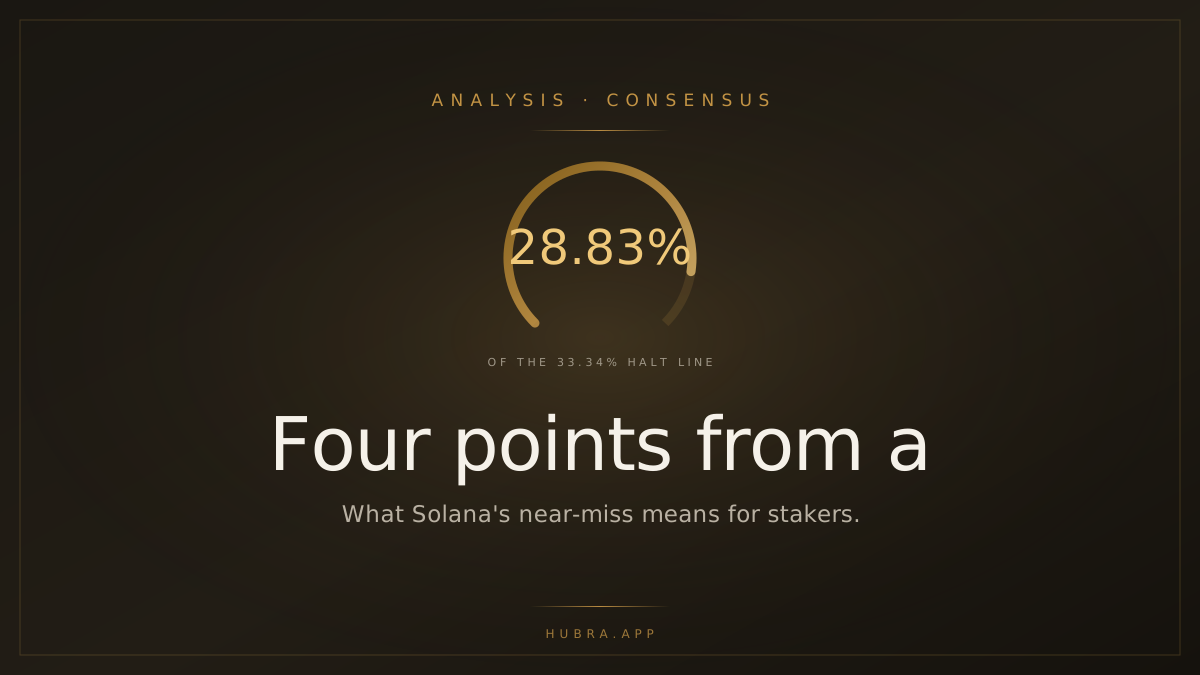
One infrastructure failure pushed nearly 29% of Solana stake offline. Finality needs more than two thirds of stake voting. Here is what stakers should check now.