
Solana's UX Gap in 2026: Why Adoption Hinges on Simpler DeFi
Solana's 2025 was a breakout - TVL up 9x, institutions issuing on-chain. Heading into 2026, the one thing still gating mainstream adoption is user experience.
TL;DR. Solana's 2025 was a breakout: TVL up 9x, millions of new users, real-world assets from JPMorgan and Galaxy Digital. Heading into 2026, the remaining adoption gap is UX, not infrastructure. For staking - the largest on-chain action SOL holders take - closing it means simple, non-custodial flows that match what people expect from traditional finance.
Solana's UX gap, going into 2026
Solana had a breakout 2025. TVL jumped 9x. Millions of users showed up. Big institutions started issuing real-world assets on-chain. The ecosystem matured fast - and none of that momentum has slowed in 2026.
But one thing still gates mainstream adoption: user experience.
As more people try DeFi, the gap between Solana's technical performance and the simplicity users expect becomes obvious. It hits hardest with retail users and active traders who want on-chain yield without wading through fragmented tools.
That's the gap Hubra is built to close - starting with the single most common thing SOL holders do on-chain: staking.
What 2025 proved
Solana went from niche experiment to one of the strongest ecosystems in Web3, and the foundation it laid is what 2026 is building on. The data told the story:
High on-chain activity: Millions of daily active addresses. Tens of millions of transactions. Engagement grew 3x year-over-year (DefiLlama).
DeFi dominance: Leading in stablecoins, DEX volume, and liquid staking (DefiLlama).
Institutional adoption: JPMorgan, R3, and Keel invested heavily in RWA on Solana, and Galaxy Digital's late-2025 bond issuance set the tone for where institutions are heading (Bloomberg). The demand is real - even Wall Street wants in on DeFi.
The infrastructure is there. The liquidity is there. The backing is there. What's still thin is the UX layer that makes it all accessible.
The UX problems holding Solana back
Despite impressive traffic and TVL, regular users still struggle. The simplicity they expect from centralized platforms? Not there yet.
Complicated flows: Users are used to streamlined CEX processes. DeFi feels daunting. The learning curve isn't just about understanding blockchain - it's about navigating interfaces that weren't built for normal people.
Fragmented tools: Yield opportunities are scattered across apps. Most platforms offer complex, single-use tools instead of an end-to-end experience. This fragmentation kills adoption.
Trust issues: Fear around non-custodial vs custodial, slashing, counterparty exposure - all of it slows onboarding. People want self-custody security without self-custody complexity.
Bottom line: without good UX, speed and scale won't attract users.
How Hubra answers Solana's UX problem
Most attempts to fix DeFi UX try to do more - bundle every yield source, every swap, every chain into one dashboard. Hubra went the other way. The simplest interface is the one that does a single thing well.
Hubra is a non-custodial staking platform for SOL and USDC on Solana. Not a super-app, not an aggregator - one job, done with the discipline serious holders deserve. We wrote about why we narrowed from a super-app to a staking specialist.
Self-custody without the complexity: Your keys stay in your wallet at every step - no counterparty, no withdrawal queue, no "not your keys" caveat - while the flow stays as clear as the centralized apps people are used to.
One decision, made clearly: Native or liquid, an amount, a confirmation. No validator spreadsheets, no protocol shopping, no ten open tabs. Rewards then accrue automatically each epoch, with nothing to claim.
That is the UX bet: not more surface area, but less. See how to stake SOL for the full flow, or how the same idea shows up on hardware in our Solana Seeker review.
Why this matters for Solana
Solana's advantages are speed, low cost, and composability. But there's a glass ceiling: adoption. The bottleneck is simplicity. Here's what good UX unlocks:
Lower onboarding friction: When the barrier is low, more people join. A CEX-like experience that stays on-chain brings the next wave of users in.
Better composability capture: Access to protocols through clean interfaces consolidates user attention and improves liquidity. The whole ecosystem benefits.
More on-chain activity: Streamlined processes encourage frequent interactions. When users can act without friction, they engage regularly.
Good UX is what translates backend advances into actual user behavior. It bridges functionality and experience.
The bottom line
Solana has the supply side: throughput, liquidity, products.
What's missing for mainstream adoption is demand-side usability - products that let normal users and traders act on opportunities without friction.
For staking specifically - the largest, most common on-chain action for SOL holders - that's where Hubra is focused. SOL and USDC staking, non-custodial, with the polish people expect from traditional finance.
Solana will keep shipping infrastructure and apps. Hubra will keep making one thing - putting SOL and USDC to work - feel as quiet and dependable as it should.
The ecosystem's next chapter isn't about transactions per second. It's about millions of holders confidently earning on-chain.
On chain since 2020. Never a day down.
Last updated: June 2026
 Analysis
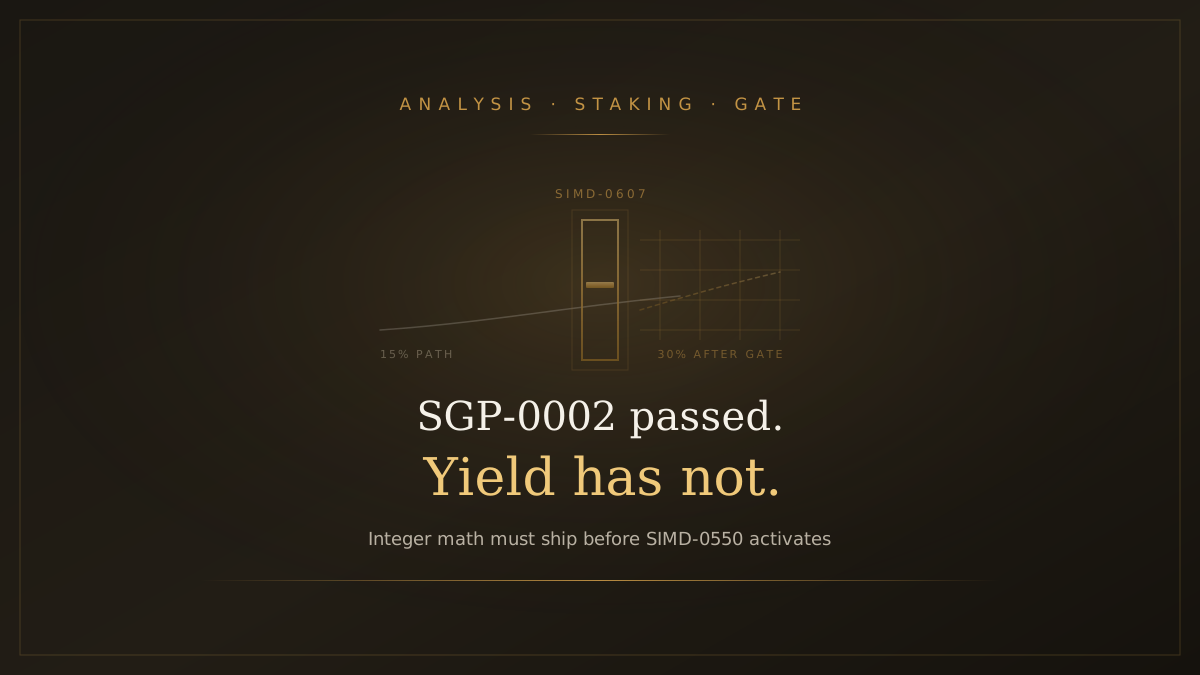
Why Solana Staking Yields Have Not Changed After SGP-0002
SGP-0002 passed by 0.334 points. Your next epoch payout did not move. Faster disinflation is gated on SIMD-0607, client releases, and a feature gate with no public activation date.
 Analysis
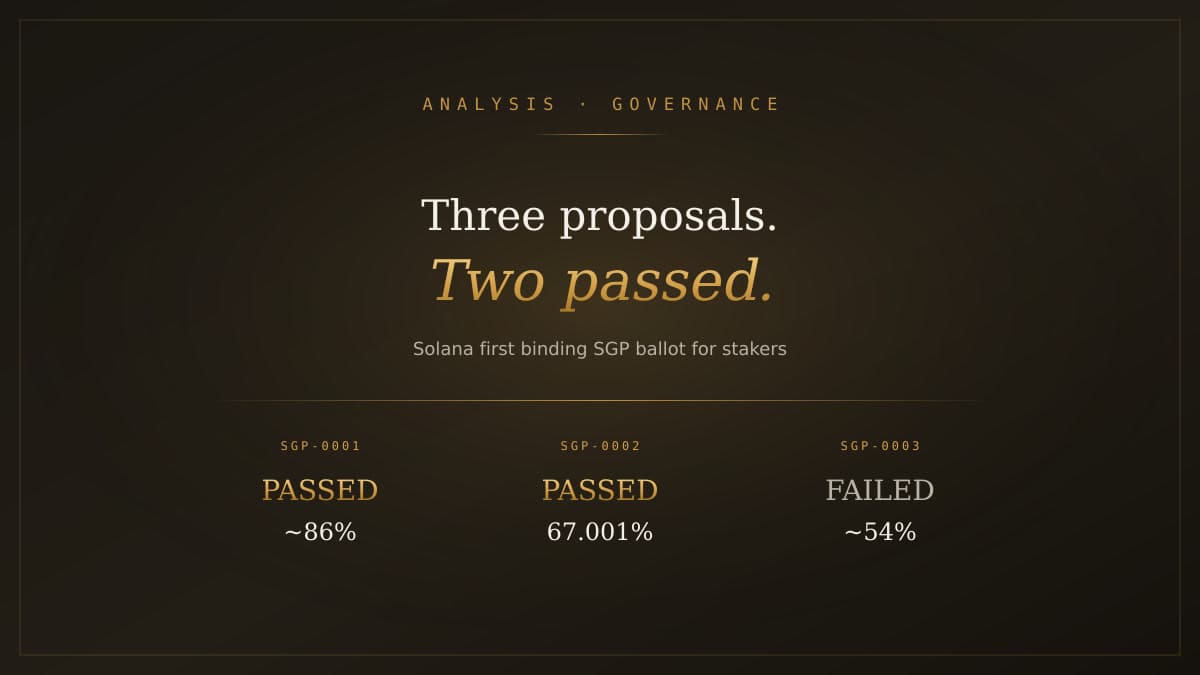
Solana's First Governance Vote: What SGP-0001, 0002, and 0003 Mean for Stakers
Three proposals. Two passed. One failed. Solana's first on-chain governance vote set the rules, sped up disinflation, and left fee burns for another day. Here is the staker briefing.
 Analysis
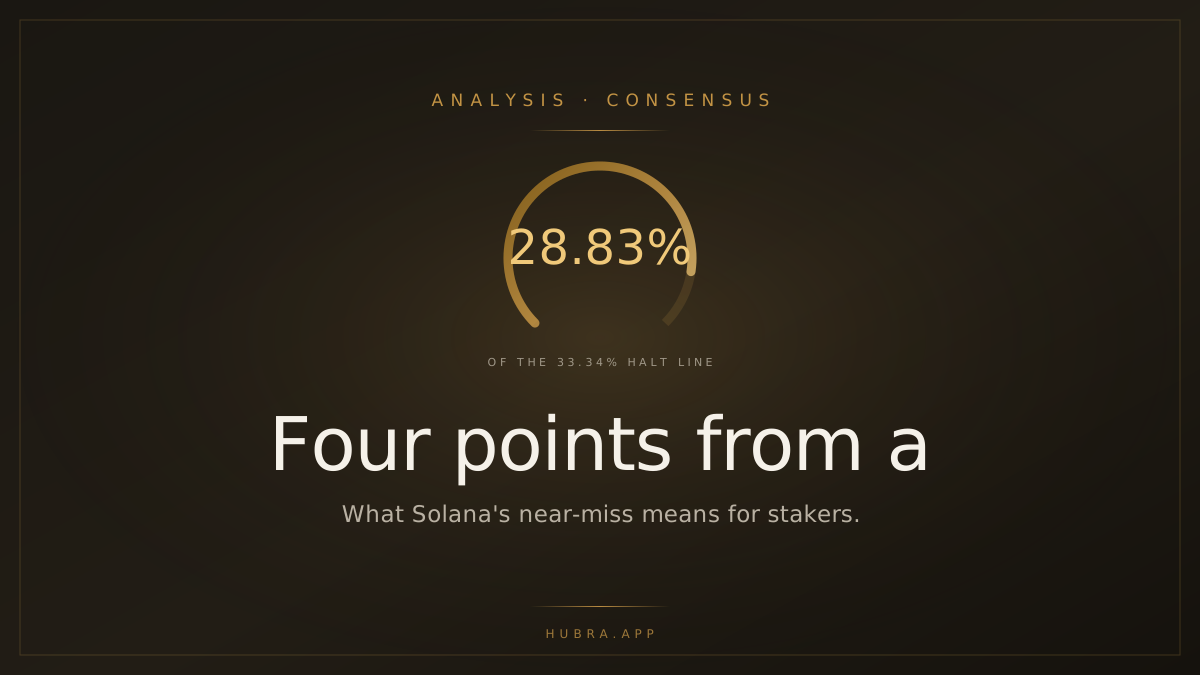
Solana Validator Concentration Risk After the Near-Halt
One infrastructure failure pushed nearly 29% of Solana stake offline. Finality needs more than two thirds of stake voting. Here is what stakers should check now.