
From super-app to staking specialist
The most important word in product strategy is no. After building toward a multi-product DeFi super-app, we're focusing on a single experience: staking, done with the discipline serious holders deserve.
Key points
- Hubra is now a non-custodial staking platform for SOL and USDC on Solana. Nothing else.
- The previous multi-product roadmap - swaps, lending, AI assistant, aggregated yield - has been retired.
- Focus on a single experience lets us take validator selection, raSOL as a receipt token, instant unstake, and the daily calm of holding seriously.
- The message anchors everything: on chain since 2020, never a day down.
The most important word in product strategy is no.
For most of the past year, Hubra was building toward something familiar to anyone who has spent time in crypto: a super-app. One interface for staking, swaps, lending, an AI assistant, a portfolio dashboard - the everything-on-one-screen vision that has tempted every serious team in this space.
We're not building that anymore.
Hubra is now a staking platform. SOL and USDC, on Solana, non-custodial. That's the entire product.
This is a piece about why.
Doing many things, loudly
Super-apps are seductive for the same reason they fail. The pitch sounds right - one app, every action, your whole on-chain life in a single dashboard. Investors nod. Engineers get to ship. Users get a tour of the bullet points.
But the math is brutal. Every additional surface dilutes the team's attention. Every new product has its own state machine, its own failure modes, its own support tickets. The all-in-one dashboard becomes a settings menu. The unified experience becomes seven loosely-connected screens with the same logo on top.
We watched this happen at every layer of the stack. We were doing it ourselves.
And in the meantime, the staking experience - the most common, most important, most under-served on-chain action for SOL holders - was something we were building as one of many features. It deserved more.
The job we want to do well
Staking on Solana is enormous and unloved. SOL holders stake billions of dollars in aggregate, and most of them do it through interfaces that haven't materially improved in three years. Validator selection is a chore. Liquid staking tokens are fragmented across protocols. Stablecoin yield is buried under five layers of UI on most platforms.
There is a better version of this. Not flashier - calmer. Not more configurable - more considered. Closer to the experience a private wealth manager would design for a careful client than the one a yield-farm dashboard would pitch to a degen.
That's the version we want to build. And to build it the way we'd want to use it ourselves, we have to stop building everything else.
What focus actually means
Focus is not a press release. It's a list of what we said no to.
- No swaps. Jupiter, Raydium, and Phantom do this exceptionally well. We aren't going to.
- No lending or borrow markets. Marginfi, Kamino, and Drift cover this surface.
- No AI assistant. Horus was a thoughtful product. It is not what we are now.
- No NFT tab, no perps tab, no "earn" tab listing third-party strategies. Each was a road that led away from the work we want to do.
What we're keeping is a single experience: stake your SOL or USDC, watch it compound, exit when you need to, with custody of your keys at every step.
Capturing every angle of one experience
When you commit to one product, you can finally take it seriously. The things we're now spending real time on:
- The first ninety seconds. From landing page to first stake, with no surprises and no jargon.
- The validator question. Most users should not have to research validators. We do that work, transparently, with a published methodology.
- The receipt. raSOL is a liquid staking token, but it's also a relationship. It should look and feel like something worth holding.
- The exit. Liquid staking is meaningless if unstaking is opaque. Instant unstake is built into the same interface, with costs visible up front.
- The rest of life. Your stake should compound while you do other things. The product should be quiet enough that you forget about it for weeks.
These are not features. They're a philosophy applied with discipline.
On the language
The way we talk about Hubra is changing too.
We are not a super-app for Solana. We are not a DeFi hub. We are not a CEX-like experience for everything.
We are a non-custodial staking platform. That sentence is the entire product. The line that sits underneath it is the entire promise:
On chain since 2020. Never a day down.
If we do this right, that line will mean something specific. It will mean that staking through Hubra feels like the most considered version of what is otherwise a routine on-chain action. It will mean that when you stake SOL or USDC here, you are choosing restraint over noise, and patience over feature-count.
What stays
Everything we've learned about product, design, and trust stays. The non-custodial architecture stays. The team stays. The discipline of building in public stays. The partnership work on programmable staking with Pye - which has always been about staking, not super-app surfaces - continues.
What changes is the surface area we're willing to point that work at. From here on, it points at one thing.
Frequently asked questions
What is Hubra now?
Hubra is a non-custodial staking platform on Solana. The product is focused on staking SOL and USDC. Keys stay in your wallet; Hubra handles validator selection, restaking, and the receipt token (raSOL) for staked SOL.
Is Hubra still a super-app?
No. Hubra was previously building a multi-product DeFi super-app that included swaps, lending, an AI assistant, and aggregated yield. As of 2026, those surfaces are discontinued and the product is focused exclusively on SOL and USDC staking.
What happened to Horus, Hubra Earn, and the swap features?
They have been retired. Other teams in the Solana ecosystem - Jupiter for swaps, Marginfi/Kamino/Drift for lending - cover those surfaces well. Hubra is reinvesting that engineering and design focus into the staking experience.
What can I stake on Hubra?
SOL (via liquid staking, receiving raSOL) and USDC (for non-custodial stablecoin yield). Both run on Solana.
Is staking on Hubra non-custodial?
Yes. Your keys remain in your wallet at every step. Hubra never takes custody of your assets.
Why focus only on staking?
Staking is the most common, highest-volume, and most under-served on-chain action for SOL holders. By specializing rather than spreading across many products, Hubra can take the staking experience seriously - validator methodology, transparent fees, calm interface, instant unstake - in a way that a super-app cannot.
What this means for users
If you're already staking SOL or USDC with us, nothing changes immediately - the product you're using continues, deepens, and improves.
If you came to Hubra for swaps, AI assistance, or aggregated yield: we've made the call that other teams in the ecosystem do those things better than we ever would have. The right move is to use them, and to come back here when the question is where should my SOL and USDC live.
Bottom line
Specialization is a slower path than general-purpose. It also tends to produce things that last.
The product we want to build is a place where SOL and USDC quietly compound, where the experience is closer to opening a private bank statement than to navigating a dashboard, where the answer to "is my staking handled properly" is something a person can actually feel.
That's what we're focused on now. Just that.
On chain since 2020. Never a day down.
Last updated 7 May 2026. Written by the Hubra Team. The journal publishes occasional notes on product, staking, and the on-chain ecosystem. See also: What is Liquid Staking? and From Delegation to Markets: Hubra × Pye.
 Partnership
From Delegation to Markets: Our Next Step in Solana Staking with Pye
Staking is one of the safest and most common ways Solana users earn on their SOL. But for all its importance, staking has remained surprisingly rigid. That's why Hubra is collaborating with Pye on programmable staking markets.
 Education
How Solana Staking Rewards Work in 2026
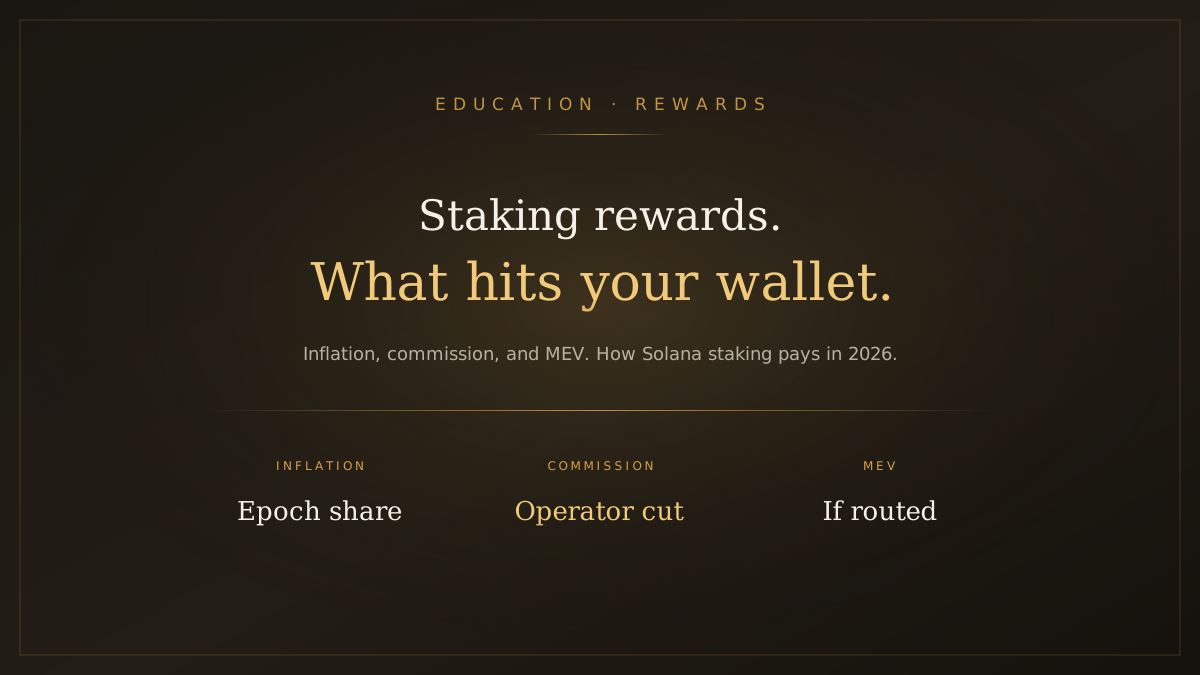
Your epoch payout is inflation rewards minus commission, plus any block or MEV share your operator routes. Here is what actually hits a staker wallet in 2026, and what has not changed yet after SGP-0002.
 Education
Solana Alpenglow Activation: What Stakers Should Check Before September 28
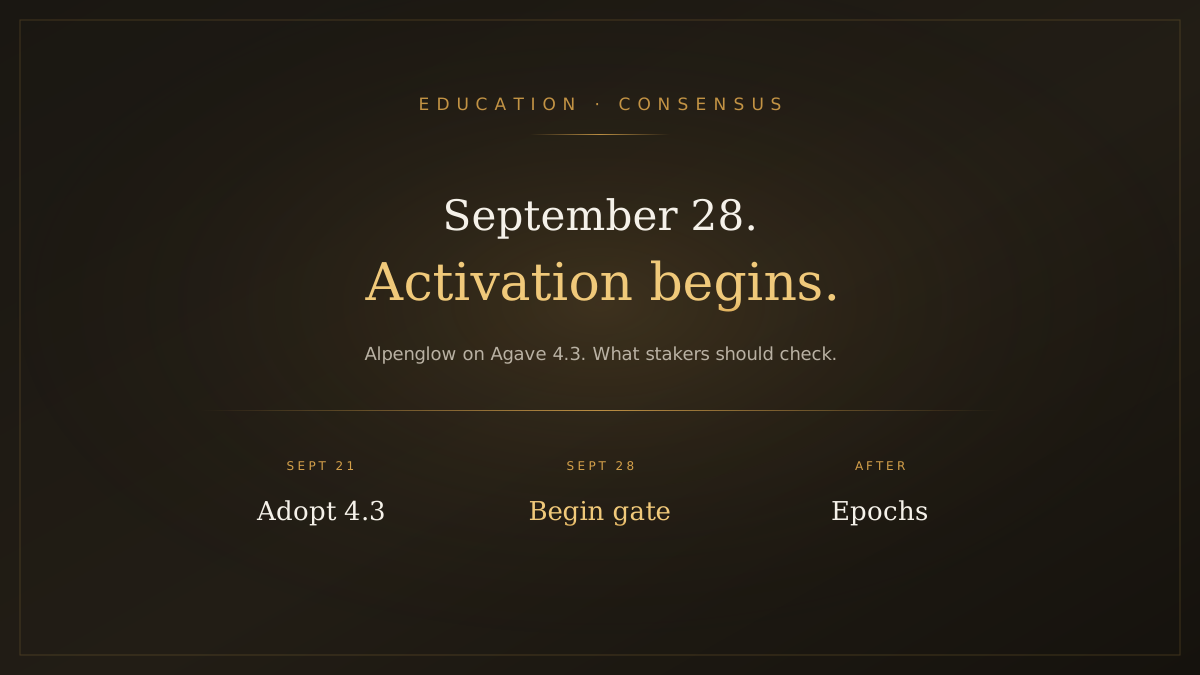
Alpenglow now has a provisional mainnet runway on Agave 4.3: general adoption September 21, begin feature activation September 28. A short checklist for stakers, not a republish of our earlier explainers.