
raSOL vs JitoSOL vs mSOL vs INF: Solana LST Compared
JitoSOL leads on liquidity, mSOL on its validator stake auction, INF on diversified fee-boosted yield, and raSOL rebates the earnings of a single long-running validator, with instant exit. Here is how the major Solana LSTs compare in 2026.
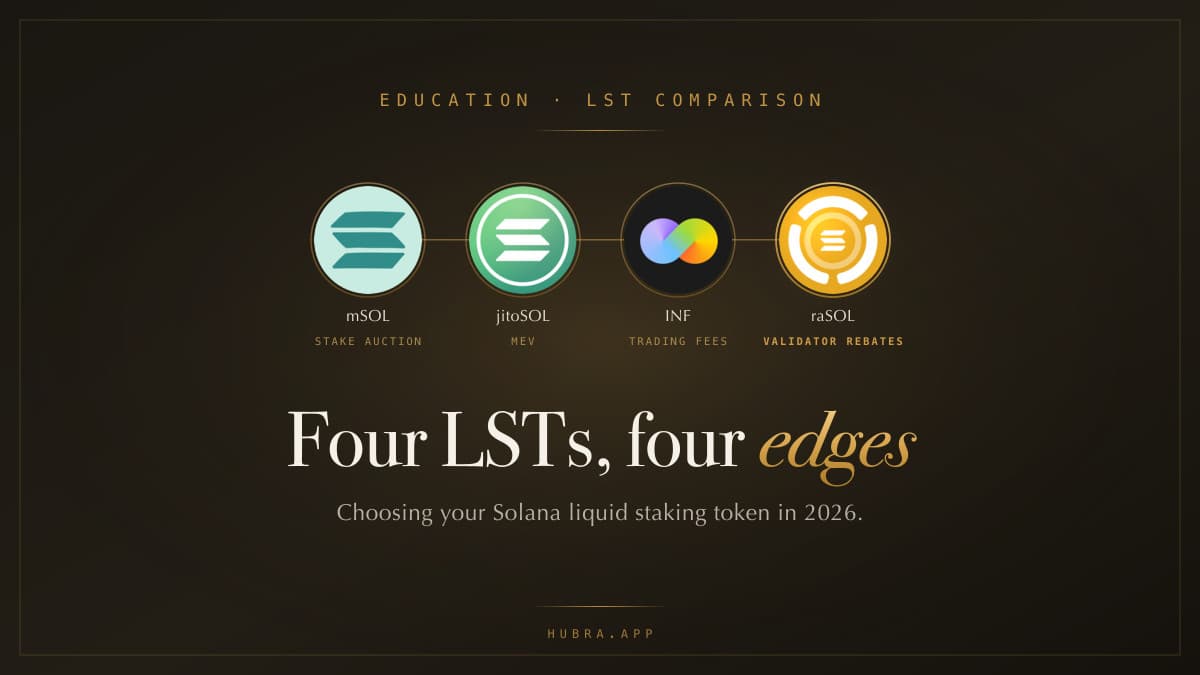
TL;DR. All the major Solana liquid staking tokens earn roughly 5 to 7% and settle through shared Sanctum liquidity, so the choice is about character, not a yield race. JitoSOL wins on liquidity depth and integrations. mSOL is the first LST on Solana and lifts yield with a validator stake auction. INF (Sanctum Infinity) is the LST index that adds swap fees on top of staking yield. raSOL runs its own validator (since 2020) and rebates the earnings, low commission plus Jito MEV, straight to stakers, with instant unstake. Pick by what you value.
If you have decided to liquid stake your SOL, the next question is which token to hold. The headline APYs are close enough that chasing the top number is the wrong way to choose, and the leaderboard reshuffles epoch to epoch. What actually separates the major Solana LSTs is how they are run: who operates the stake, how MEV is handled, how deep the exit liquidity is, and how decentralized the delegation is. This guide compares the four that matter most for SOL holders in 2026.
The four at a glance
| raSOL (Hubra) | JitoSOL (Jito) | mSOL (Marinade) | INF (Sanctum) | |
|---|---|---|---|---|
| Backing | Single validator, operated since 2020 | Large multi-validator pool | Large multi-validator pool | Index of multiple LSTs |
| APY band (2026) | ~5 to 7%, MEV included | ~5 to 7%, MEV included | ~5 to 6%, MEV + stake auction | ~6 to 7%, staking + swap fees |
| MEV | Jito client, rebated in full | Captured and shared (pioneer) | Captured, auto-compounded | Inherited from underlying LSTs |
| Liquidity / integrations | Sanctum-backed from day one | Deepest in the category | Broad, well-established | Is the shared liquidity layer |
| Decentralization | Single transparent operator | Many validators | Many validators, anti-concentration | Spread across many issuers |
| Instant exit | Yes, raSOL and native, via Hubra | Via DEX swap | Via DEX swap | Via DEX swap |
| Best for | Rebated yield + instant exit | Depth and DeFi composability | Auction-boosted yield + track record | Diversified, fee-boosted yield |
APY figures are bands, not quotes. Rates move every epoch. Verify the live number before depositing.
JitoSOL: the liquidity leader
JitoSOL is the largest Solana liquid staking token by total SOL staked, with more than 14 million SOL in the pool, and it pioneered MEV sharing on Solana. Its validator set runs the Jito client, which captures value from transaction ordering (MEV) and routes a share to holders. That MEV capture once gave it a clear yield lead, but as its stake base grew the same MEV is now split across far more holders, so its headline APY has compressed toward the middle of the pack rather than topping it.
Its real edge is depth. JitoSOL has the most trading pairs and the most DeFi integrations, so it is the easiest LST to use as collateral, in liquidity pools, or as a base asset, with the lowest slippage at size. If your plan is to deploy your staked SOL actively across Solana DeFi, JitoSOL is the path of least resistance.
The trade-off is concentration: it is a large pool, and you are trusting Jito's delegation and infrastructure rather than picking an operator yourself.
mSOL: the stake-auction LST
Marinade launched mSOL as the first liquid staking token on Solana, and it still has the largest holder base of any LST. Its defining feature today is how it earns: the stake auction. Through Marinade's stake auction marketplace, validators bid for delegation from the Marinade stake pool, paying for the stake they win, and those payments are passed back to mSOL holders as extra yield on top of base staking rewards.
That auction is where mSOL's yield edge comes from. Marinade also captures MEV and auto-compounds it into the mSOL exchange rate every epoch, so between the winning bids and MEV its rate stays competitive with JitoSOL, and the two trade places epoch to epoch. Marinade still spreads stake across many validators, and mSOL is broadly integrated across Solana lending and DEX venues, so DeFi usability is strong if not quite JitoSOL's depth.
The trade-off is the same as any large pool: you are trusting Marinade's stake pool and its auction, not choosing the validator yourself.
INF: the index that earns swap fees
INF, Sanctum's Infinity token, is not a single liquid staking token at all. It is an index: a basket of vetted Solana LSTs held in one pool. Holding INF earns you the blended staking yield of everything in the basket, plus a cut of the trading fees generated every time someone swaps between LSTs through Sanctum's shared liquidity layer, which is the same layer every other token here settles through.
That second revenue stream is why INF has frequently topped the LST APY rankings in 2026. When swap volume is high, fee income lifts its blended rate above tokens that earn staking rewards alone, and because it inherits MEV from the LSTs it holds, that yield is already baked in. The trade-off is that you are holding a basket, not picking an operator, so your exposure is spread across multiple issuers and validators rather than concentrated in one.
INF suits holders who want diversified, fee-boosted yield and are comfortable trusting Sanctum's index rather than a specific validator.
raSOL: a single operator that rebates what it earns
raSOL takes a different shape. Instead of a large multi-validator pool, it is backed by a single validator that Hubra has operated continuously since 2020. That is a deliberate choice: one transparent, accountable operator with a public vote identity and a long uptime record, rather than an algorithm spreading stake across hundreds of nodes.
That structure is where raSOL's yield edge comes from: rebates. Because Hubra both runs the validator and issues the token, it is not delegating your stake to outside validators and paying away their commissions. Instead it rebates its own validator earnings straight back to stakers, a low commission plus the Jito MEV the validator captures (it runs the Jito client), returned rather than kept. Most LST pools have to share economics with the operators they delegate to; raSOL keeps the full validator stack in-house, so there is no middle layer taking a cut.
On liquidity, raSOL settles on Sanctum infrastructure, which means it has deep exit liquidity from day one despite being newer, and you can swap it against any other LST in a single transaction. And because Hubra operates the full surface, raSOL supports instant unstake for both the token and native stake accounts, not just a DEX swap.
raSOL suits holders who want to know exactly who is running their stake, want validator earnings and MEV rebated without managing any of it, and want a calm, non-custodial home for SOL, ideally on one platform that also handles their native staking and USDC.
The honest trade-off: raSOL is a single-validator LST, so it does not offer mSOL's multi-validator spread, and it is younger than JitoSOL, so its raw integration count is smaller, even though its liquidity is not.
So which LST should you hold?
- Hold JitoSOL if your priority is the deepest liquidity and the widest DeFi integration, and you want MEV exposure with the lowest exit slippage at size.
- Hold mSOL if you want the first and most established LST, where a validator stake auction adds yield on top of staking rewards and MEV.
- Hold INF if you want diversified exposure across many LSTs and a yield that picks up extra swap fees on top of staking rewards, without choosing a single operator.
- Hold raSOL if you want a transparent single operator with a six-year record that rebates its validator earnings, low commission and Jito MEV, straight to you, with day-one Sanctum liquidity and instant exit, all on a platform built specifically for staking.
The reassuring part: because all of them settle through Sanctum's shared liquidity, you are not locked in. You can move between them in one transaction as your priorities change. Choosing an LST in 2026 is a low-stakes decision, so pick the operator and the character you trust, not the highest number on a dashboard.
Ready to choose? Mint raSOL on Hubra, compare the routes in our liquid staking guide, or weigh staking styles in native vs liquid staking.
This article is for educational purposes only and is not financial advice. APY and TVL figures are bands that change with network conditions; verify current numbers before depositing.
 Education
What You Can Do With raSOL in Solana DeFi
Your staked SOL does not have to sit still. Five ways to put raSOL to work across Solana DeFi, from Kamino loops to Meteora liquidity, and the risks of each.
 Education
What is Liquid Staking? Complete Guide for 2026
Liquid staking lets you earn staking rewards while keeping your assets usable. This guide explains how it works, compares major Solana LSTs, and helps you decide which approach fits your goals.
 Education
How to Stake SOL in 2026: A Complete, Practical Guide
A plain-English walkthrough of how to stake SOL in 2026: the two main routes, how to pick a validator, what APY to expect, how to exit, and the risks worth knowing, written plainly.