
Native vs Liquid Staking on Solana: Which Is Better in 2026?
Native staking and liquid staking both earn SOL rewards, but they trade off custody, liquidity, and risk very differently. Here is a plain comparison and a simple way to choose.
TL;DR. Native staking delegates SOL straight to a validator: cleanest custody, full reward, but your SOL is locked for an epoch when you exit. Liquid staking gives you a transferable token (like raSOL) you can use in DeFi and exit instantly, at the cost of a small fee and added smart-contract risk. Hold long term and want simplicity? Go native. Want flexibility and composability? Go liquid.
If you want to earn yield on SOL, you will quickly hit one fork in the road: native staking or liquid staking. Both pay you for helping secure Solana. They differ in what you give up to get that yield. This guide compares them honestly and gives you a simple way to decide.
The one-sentence version
Native staking is delegation. Liquid staking is delegation plus a receipt token you can move around.
Everything else, custody, APY, liquidity, and risk, follows from that single difference.
Native vs liquid staking, side by side
| Factor | Native staking | Liquid staking |
|---|---|---|
| What you hold | A stake account delegated to a validator | A liquid staking token (raSOL, JitoSOL, mSOL) |
| Custody | Fully self-custodial, no protocol layer | Self-custodial token, but a smart contract sits underneath |
| Net APY | Full protocol reward (highest) | Slightly lower, after a protocol fee |
| Exit speed | One epoch (about 2 to 3 days) unless you use instant unstake | Instant, by swapping the token |
| DeFi use | None, the SOL is locked | Full, use the token as collateral, in LPs, etc. |
| Validator choice | You pick the validator | The protocol or platform handles it |
| Risk surface | Validator performance only | Validator + smart contract + liquidity |
| Taxes | Rewards as they accrue | Same, plus possible events when you trade the token |
Custody: both keep your keys
A common myth is that liquid staking is custodial. It is not, in the sense that matters: your liquid staking token sits in your own wallet, not on an exchange.
The real custody difference is the protocol layer. With native staking, your SOL is governed only by Solana's stake program; you delegate voting rights and nothing else. With liquid staking, a smart contract holds the underlying stake and issues you a token. You still control the token, but you are now trusting that contract to behave.
Both are very different from staking on a centralized exchange, which is genuinely custodial: the exchange holds your assets and can freeze withdrawals.
APY: native wins, but barely
Native staking pays the full protocol reward, currently in the ballpark of 5 to 7% depending on the epoch and total stake. Liquid staking protocols take a cut, usually 5 to 10% of the rewards, so the headline APY lands roughly 0.3 to 0.5% lower.
That gap is small. For most holders it is dwarfed by the value of being able to exit instantly or use the position in DeFi. If you are optimizing purely for raw yield and never need liquidity, native is the marginally better number. To see the math on your own balance, run the staking calculator.
Liquidity: liquid staking's whole point
This is the real trade. With native staking, exiting means deactivating your stake account and waiting one epoch (about 2 to 3 days) before the SOL is withdrawable. With a liquid staking token, you can swap to SOL whenever you want.
The line is blurrier than it used to be. Hubra offers instant unstake for native stake accounts too, routing the active account through Sanctum's pooled liquidity so you exit in a single transaction. So native staking is no longer strictly illiquid, but liquid staking still gives you a token you can deploy elsewhere while it earns.
Risk: liquid staking adds a layer
Both routes share validator risk: if your validator underperforms, you earn less (Solana does not currently slash principal). Liquid staking adds two more risks on top:
- Smart contract risk. A bug or exploit in the protocol could put funds at risk. Mitigation: stick to audited, high-TVL protocols.
- Depeg and liquidity risk. In stressed markets, a liquid staking token can briefly trade below its fair SOL value, and thin pools cost more to exit.
None of these are unique to Solana, and the major protocols have weathered full market cycles. But the honest framing is that native staking has the smaller risk surface. We go deeper on this in our liquid staking guide.
How to choose
Use this quick test:
- Choose native staking if you are holding SOL for the long term, you want the cleanest custody and the highest net APY, and you rarely need to move quickly. See native SOL staking.
- Choose liquid staking if you want to keep earning while using your position as DeFi collateral, you value instant exit, or you hold less than 1 SOL (pooled staking is not bound by the 1 SOL native minimum). See raSOL liquid staking.
- You can do both. Many holders keep a long-term native delegation and a smaller liquid position for flexibility. They are not mutually exclusive.
Bottom line
There is no universally correct answer, only the right fit for how you use your SOL. Native staking is the disciplined, low-surface default. Liquid staking buys you flexibility for a small, well-understood cost. If you understand the table above, you already know which one is yours.
Ready to stake? Compare native staking and raSOL liquid staking on Hubra, or read how Solana staking works first.
This article is for educational purposes only and is not financial advice. APYs vary with network conditions; verify current rates before depositing.
 Education
Solana's new 1 SOL minimum to stake, explained
Solana's stake program now needs at least 1 SOL to open a new native stake account. Existing stake is untouched. Here is what SIMD-0490 changed.
 Education
What You Can Do With raSOL in Solana DeFi
Your staked SOL does not have to sit still. Five ways to put raSOL to work across Solana DeFi, from Kamino loops to Meteora liquidity, and the risks of each.
 Education
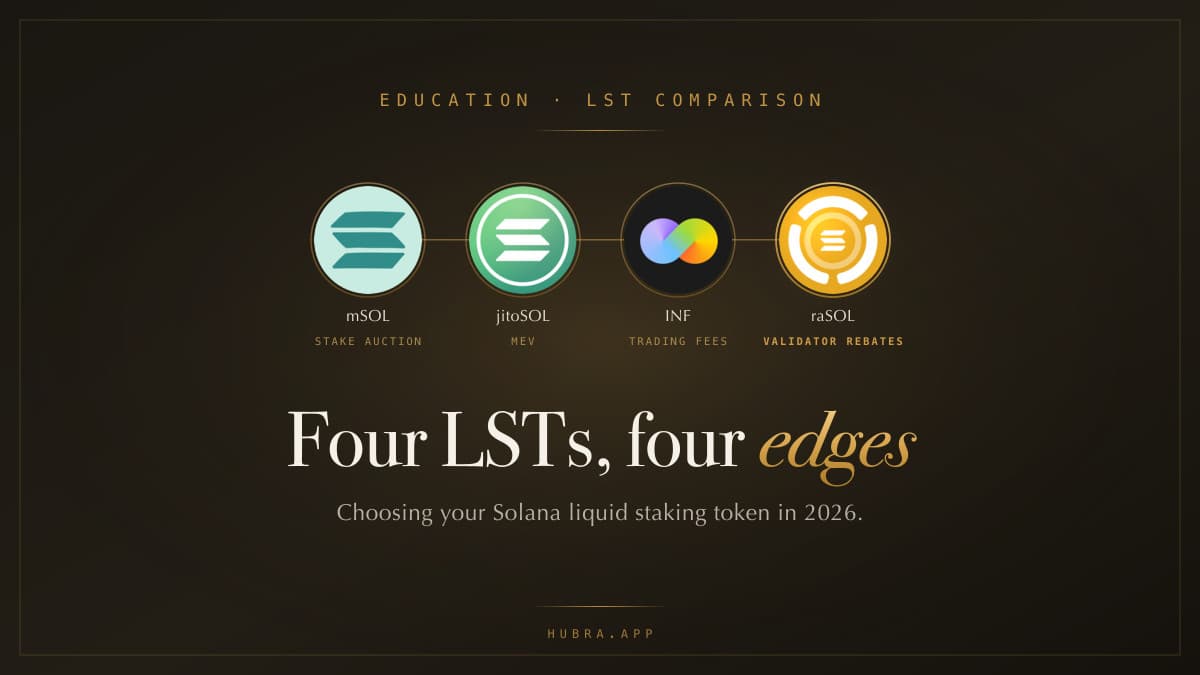
raSOL vs JitoSOL vs mSOL vs INF: Solana LST Compared
JitoSOL leads on liquidity, mSOL on its validator stake auction, INF on diversified fee-boosted yield, and raSOL rebates the earnings of a single long-running validator, with instant exit. Here is how the major Solana LSTs compare in 2026.