
How to Stake SOL in 2026: A Complete, Practical Guide
A plain-English walkthrough of how to stake SOL in 2026: the two main routes, how to pick a validator, what APY to expect, how to exit, and the risks worth knowing, written plainly.
TL;DR. To stake SOL: pick a route (native for the cleanest custody, liquid for a usable token), connect a self-custodial wallet, choose an amount, and confirm. Expect ~5 to 7% APY, paid automatically each epoch. New native stake accounts need at least 1 SOL; liquid staking has no such floor. Exiting takes an epoch natively, or is instant with a liquid token. You keep custody throughout.
Staking is the simplest way to earn yield on SOL you already hold. Instead of letting it sit idle, you put it to work helping secure the Solana network, and you get paid for it. This guide is for people who already have SOL in a wallet and just want the staking decision, made clearly, without jargon or fixed-return promises.
New to Solana entirely - no wallet yet, no SOL? Start with our beginner's guide to using Solana, which covers wallets, seed phrases, and buying SOL, then come back here for the staking step.
What does staking SOL actually do?
When you stake SOL, you delegate it to a validator, a computer that helps run the Solana network by voting on blocks. In return, the protocol pays you a share of newly issued SOL. Crucially, delegating does not hand over your coins: in native staking, custody stays with your wallet and you are only delegating voting rights. You can read the full mechanics in our staking mechanics explainer.
Step 1: Choose how to stake
There are two self-custodial routes, plus one to avoid if custody matters.
Native staking
You delegate SOL directly to a validator. Cleanest custody, no protocol layer, and the highest net APY. The trade-off: exiting takes about one epoch unless you use instant unstake. Best for long-term holders. See native SOL staking.
Liquid staking
You deposit SOL and receive a liquid staking token (an LST) such as raSOL. The token represents your staked SOL, appreciates as rewards accrue, and can be used across Solana DeFi or swapped back to SOL instantly. Slightly lower APY after fees, plus smart-contract risk. Best for flexibility. See raSOL liquid staking.
Centralized exchanges (the route to avoid)
Exchanges like Coinbase or Binance offer one-click staking, but they custody your assets and can freeze withdrawals. Convenient, but you give up self-custody, the whole point of crypto for many people.
Still deciding? Read native vs liquid staking for a head-to-head.
Step 2: Pick a validator (or let a platform do it)
If you stake natively, you choose a validator. The things that matter:
- Uptime and track record. A validator that misses votes earns you less. Look for a long, consistent operating history.
- Commission. The cut the validator takes from your rewards. Lower is better, all else equal.
- Decentralization. Spreading stake away from the largest validators strengthens the network.
Hubra has operated a Solana validator continuously since 2020; our approach is documented in our validator philosophy. With liquid staking, validator selection is handled for you.
Step 3: Decide how much to stake
Since June 2026, opening a new native stake account requires at least 1 SOL under SIMD-0490. Liquid staking and pooled staking are not bound by that floor, so smaller balances can still earn. Whatever route you pick, leave a little SOL unstaked to cover transaction fees. Full detail in our Solana minimum stake guide.
Want to see what a given amount earns over time? Use the Solana staking calculator.
Step 4: Stake
The flow is short and self-custodial:
- Open the staking app and connect your Solana wallet.
- Choose native or liquid staking.
- Enter the amount of SOL.
- Confirm the transaction in your wallet.
That is it. Your SOL begins activating, and once active it earns rewards every epoch automatically, with nothing to claim or compound by hand.
What APY should you expect?
Roughly 5 to 7% APY in 2026, varying by epoch, total network stake, and validator commission. Liquid staking runs slightly lower after protocol fees. These rewards are variable, not guaranteed: they track Solana's inflation schedule, which steps down over time. Be skeptical of any platform promising dramatically higher returns, there is usually hidden risk.
How to unstake
- Native, standard: deactivate and wait about one epoch (2 to 3 days); then withdraw. No fee beyond the network.
- Liquid: swap your LST back to SOL instantly on a DEX or through the platform.
- Native, instant: platforms like Hubra route an active stake account through pooled liquidity so you exit in one transaction. See instant unstake.
Risks worth knowing
- Validator underperformance reduces rewards (Solana does not currently slash principal).
- Smart-contract risk applies to liquid staking, not native. Stick to audited protocols.
- Market risk on the SOL price itself is always present; staking does not hedge it.
- Taxes: most jurisdictions treat staking rewards as income when they accrue. Talk to a professional.
Bottom line
Staking SOL is low-effort and self-custodial when you do it right. Decide between native and liquid, pick a credible validator (or a platform that has), mind the 1 SOL native minimum, and let rewards compound each epoch. If you want the cleanest version of this, stake with Hubra.
This article is for educational purposes only and is not financial advice. Staking rewards are variable and depend on network conditions. Verify current rates and details before acting.
 Education
How to Use Solana Safely: A Beginner's Guide (2026)
From zero wallet to your first stake, in five clear steps. A practical, measured walkthrough of how to use Solana safely - wallet, seed phrase, buying SOL, spotting scams, and earning your first rewards.
 Education
What You Can Do With raSOL in Solana DeFi
Your staked SOL does not have to sit still. Five ways to put raSOL to work across Solana DeFi, from Kamino loops to Meteora liquidity, and the risks of each.
 Education
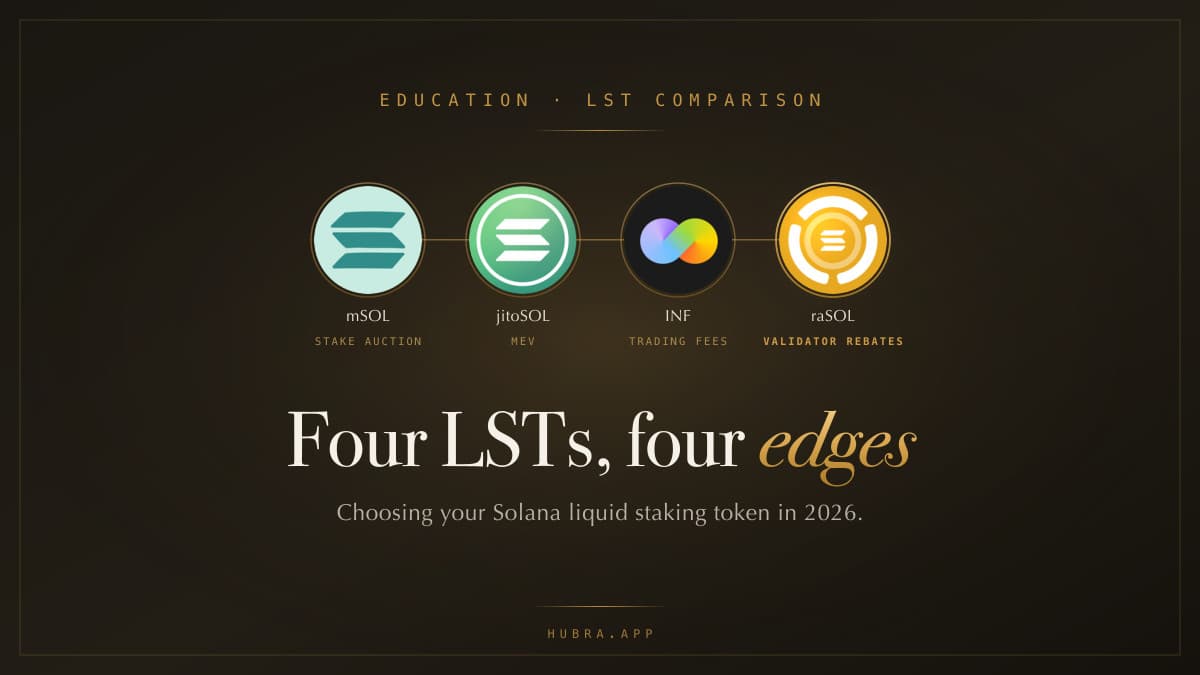
raSOL vs JitoSOL vs mSOL vs INF: Solana LST Compared
JitoSOL leads on liquidity, mSOL on its validator stake auction, INF on diversified fee-boosted yield, and raSOL rebates the earnings of a single long-running validator, with instant exit. Here is how the major Solana LSTs compare in 2026.