
Partial Unstake on Solana: Take Part of Your Native Stake Out Without Ending It
You do not have to close a whole Solana stake account to get some SOL back. Split it, exit the slice, and let the rest keep earning. Here is how the split works, what it costs, and when each exit makes sense.
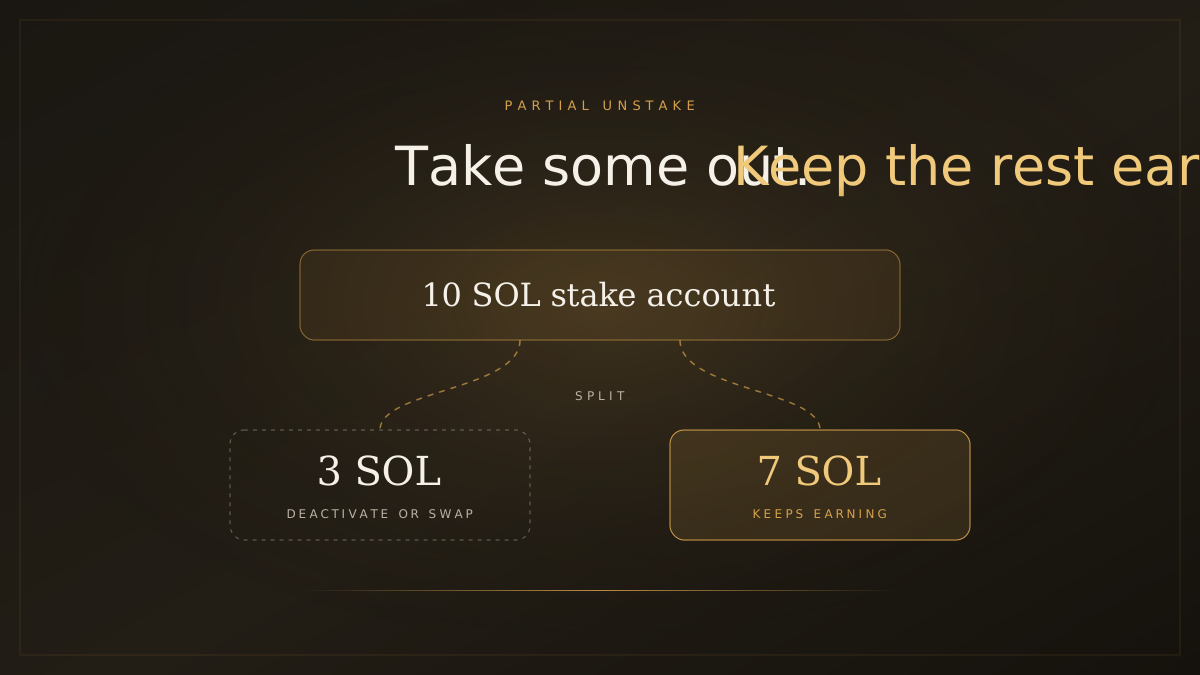
TL;DR. You cannot deactivate part of a Solana stake account. You split it first. Say you have 10 SOL staked and want 3 SOL back: split off a 3 SOL account, then either deactivate it (SOL is withdrawable at the next epoch boundary, minutes to about 25.5 hours right now) or swap it for SOL through Sanctum when pool liquidity covers the size, at a live quote with price impact and fees. The other 7 SOL never stops earning.
If you searched partial unstake solana or how to unstake part of solana stake, the answer is short: split, then exit the slice. The details matter more when the stake is large, so this post walks through them.
As of 29 October 2026.
Why you can't just unstake 3 SOL
On Solana, the unit the stake program works with is the stake account, not an amount. Deactivate an account and the whole balance starts cooling down. There is no "deactivate 3 SOL of this" option.
That is the reason the split instruction exists. It moves some lamports out of an existing stake account into a brand new one. Both accounts end up with the same stake authority, withdraw authority, and delegation. From there each account lives its own life.
The 10 / 3 / 7 example
This is the same example used in the Hubra docs:
existing stake account (10 SOL active)
        |
        |  split
        v
+-------------------+---------------------+
|  slice (3 SOL)    |  remainder (7 SOL)  |
|  exit this one    |  keeps earning      |
+-------------------+---------------------+
- Start: one stake account, 10 SOL, active and delegated.
- Split: a new stake account is created holding 3 SOL. The original now holds 7 SOL.
- Exit the 3 SOL slice by one of the two routes below.
- The 7 SOL account keeps its delegation and earns rewards every epoch as before.
Rewards that already landed in the 10 SOL account are part of the balance you split, so nothing is lost on the remainder.
The rules of a split
A few on-chain rules decide whether a split works and what it costs.
| Rule | What it means for you |
|---|---|
| New account needs its own rent-exempt reserve | About 0.00167 SOL for a 200-byte stake account per public RPC today (Hubra docs round to ~0.002 SOL) |
| Minimum delegation on each side | Each delegated account must keep at least 1 SOL of stake (per mainnet RPC on Oct 29, 2026) plus its reserve |
| Activation state carries over | Split an active account and the slice is active immediately. No new warmup. |
| Same authorities and delegation | The slice points at the same validator until you change it |
So a 10 SOL account split into 3 and 7 clears the minimum easily. Trying to carve 0.4 SOL out of an active account will fail, because that slice would sit below the minimum delegation. If you only need a small amount, it is usually simpler to wait for rewards or exit a larger slice.
Anza's CLI guide covers the same mechanics with the solana split-stake command, if you prefer doing it by hand: Delegate stake (Anza docs).
Route 1: deactivate the slice and wait
The slow route uses nothing but the stake program.
- Deactivate the 3 SOL slice.
- Wait for the next epoch boundary. At this week's pace that is anywhere from minutes to about 25.5 hours, depending on where you are in the epoch.
- Withdraw the 3 SOL to your wallet.
There is no price impact and no third party. You pay only normal network fees. There is also a network-wide limit of 9% of effective stake finishing cooldown per epoch, but recent flows have sat far below it, so in practice a normal deactivation clears at the next boundary.
We went through epoch timing after Alpenglow in detail in Solana unstaking after Alpenglow, so we won't repeat it here.
Route 2: swap the slice for SOL through Sanctum
The fast route hands the active slice to a Sanctum liquidity pool in exchange for SOL. The pool takes over the stake account and handles its deactivation. You get SOL when the transaction confirms.
Sanctum's depositStake flow takes a whole stake account. That is exactly why the split comes first: you route the 3 SOL slice, not the 10 SOL parent.
Be clear about the conditions:
- It works only when the pool has enough liquidity for your size.
- The quote includes price impact and any route fees, and it moves with pool depth and market conditions.
- Quotes are estimates. The final amount can differ slightly between quote and broadcast.
- If the quote is poor or the pool cannot fill it, fall back to Route 1.
Hubra docs say partial native unstake works this way in the app: the stake account is split first, the slice you specify is routed through Sanctum, and the rest stays earning. You see a live quote before you sign. See Native staking and Instant unstake on docs.hubra.app.
Which route for which size
Start from how soon you need the SOL, then check the quote.
| Situation | Practical move |
|---|---|
| You can wait up to about a day | Split and deactivate the slice. Lowest cost and no price impact. |
| You need SOL soon and the slice is modest | Split and quote a Sanctum swap. Take it only if the price impact works for you. |
| Large slice on a deadline | Split into several slices. Swap the ones the pool covers cleanly and deactivate the rest. |
| You want a different validator for part of the stake | Split, deactivate the slice, then delegate it to the new validator after cooldown (a new warmup starts). The other 7 SOL stays where it is. |
For larger holders the split is also a planning tool. You can keep a core position delegated and peel off slices for liquidity needs without touching the rest, which beats closing a big account and re-staking it later through another warmup.
Quick checklist before you split
- Check that both sides stay above the minimum delegation plus reserve.
- Decide the exit for the slice before you split: deactivate or swap.
- If swapping, read the live quote and the price impact at your exact size.
- If deactivating, check the epoch clock (
solana epoch-info) so you know roughly when the SOL frees up. - Keep the remainder delegated. It keeps earning without any further action.
If you are still choosing between native and liquid staking in the first place, native vs liquid staking covers the tradeoffs.
 Education
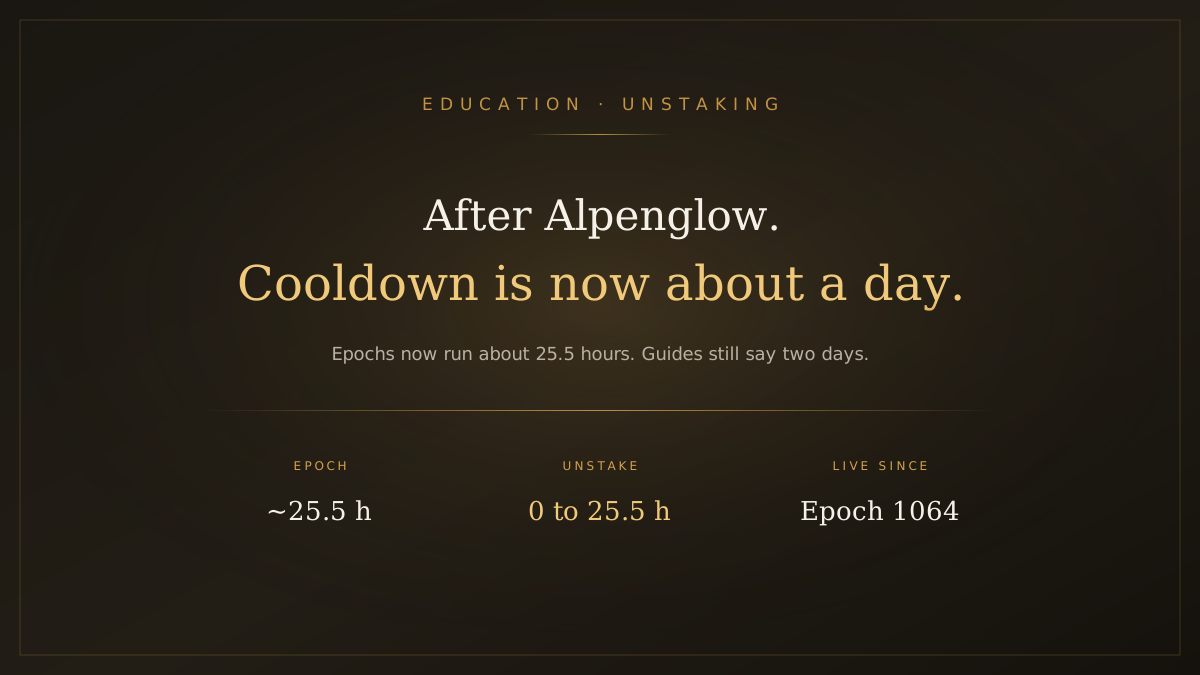
Solana Unstaking After Alpenglow: Cooldown Is Now About a Day
Alpenglow is live. Epochs now run about 25.5 hours, so a normal Solana unstake cooldown finishes at the next boundary somewhere between minutes and about a day. Most mainstream guides still say two days.
 Education
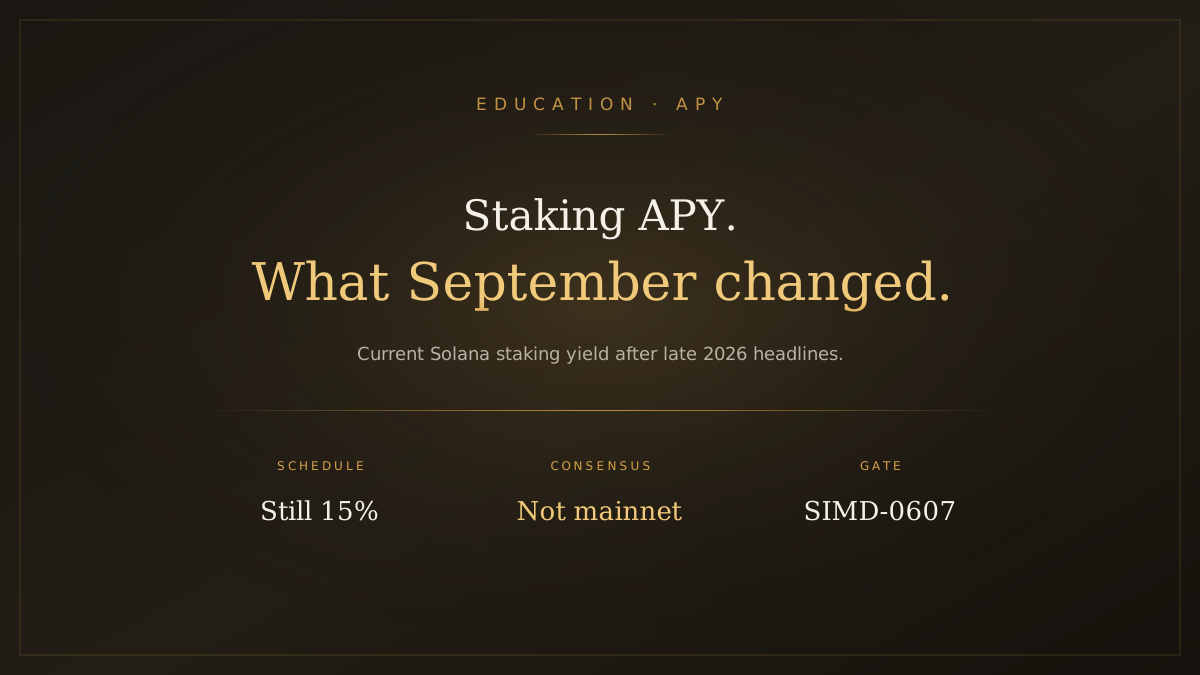
Current Solana Staking APY in Late 2026: What September Changed
Looking up current Solana staking APY after September? The number still tracks inflation minus commission, plus any routed MEV. Sept 28 did not flip mainnet Alpenglow, and faster disinflation is still gated.
 Education
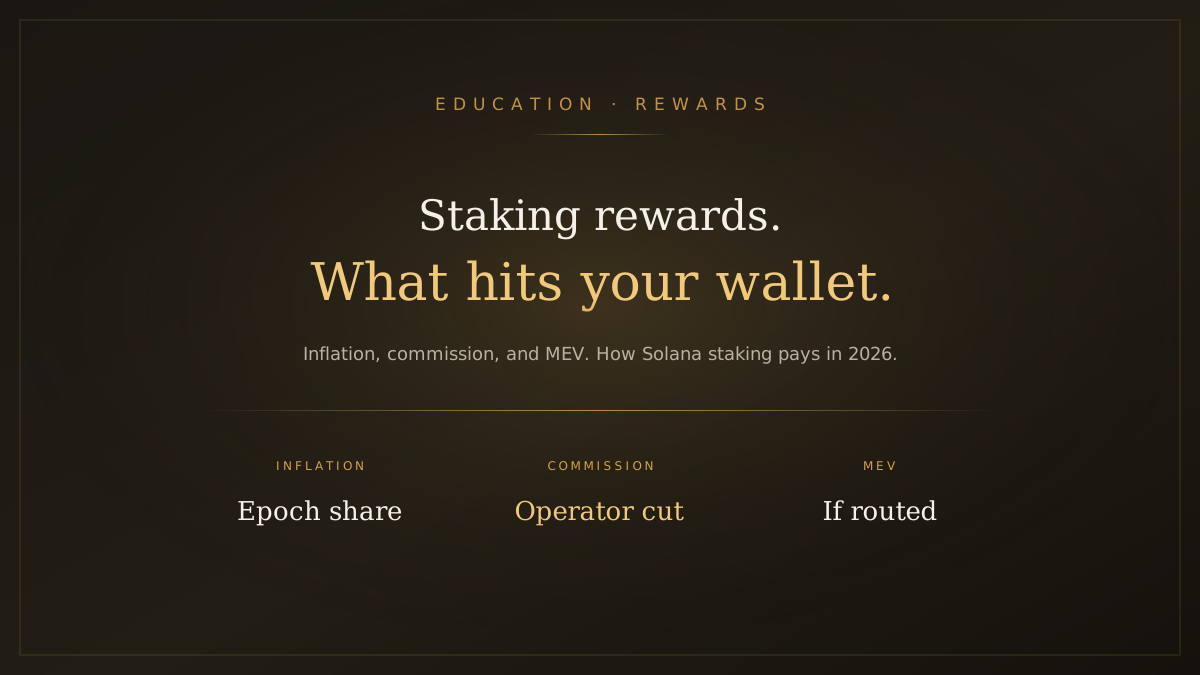
How Solana Staking Rewards Work in 2026
Your epoch payout is inflation rewards minus commission, plus any block or MEV share your operator routes. Here is what actually hits a staker wallet in 2026, and what has not changed yet after SGP-0002.