
Solana Unstaking After Alpenglow: Cooldown Is Now About a Day
Alpenglow is live. Epochs now run about 25.5 hours, so a normal Solana unstake cooldown finishes at the next boundary somewhere between minutes and about a day. Most mainstream guides still say two days.
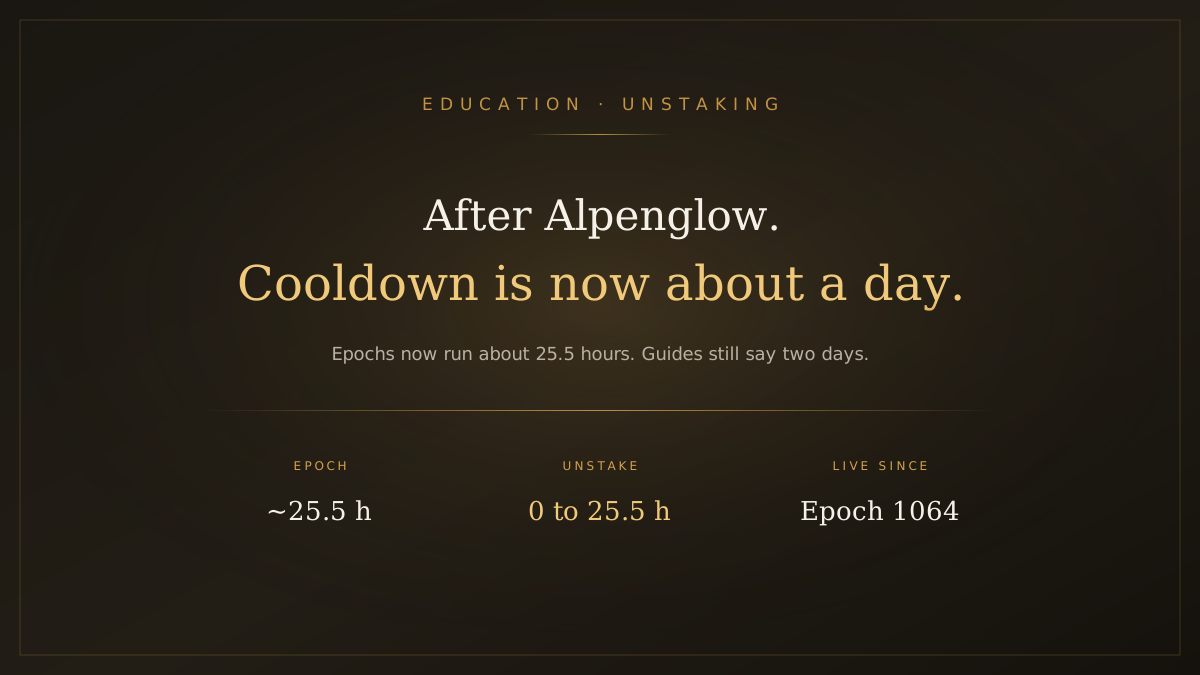
TL;DR. Alpenglow has been live on Solana mainnet since epoch 1064 (about 13:54 UTC on 21 October 2026). Recent epochs run about 25.5 hours, not the old ~2 day clock. A normal Solana unstake cooldown still ends at the next epoch boundary, so the wait is about 0 to 25.5 hours, not a fixed day. Many top guides still say 2 to 3 days. If you hold raSOL, a Sanctum swap can skip the wait when pool liquidity covers your size, with live price impact and fees.
If you searched solana unstake time or solana unstake cooldown this week, you will still find pages that say two days. We checked those pages, then measured how long epochs actually ran after Alpenglow. The short version: the stake rules did not flip, the wall clock did.
As of 29 October 2026.
Alpenglow is live. Epochs got shorter.
Alpenglow is Solana's new consensus protocol. It took over on mainnet during epoch 1064, at about 13:54 UTC on Wednesday, 21 October 2026. The Alpenglow genesis block is slot 459,652,999, and Alpenglow consensus runs from slot 459,653,000. Anza marks mainnet-beta migration as completed.
What stakers feel first is not the 150 ms finality headline. It is the shorter epoch.
An epoch is still 432,000 slots. Wall-clock length is slot time times that fixed count. Slots now average about 210 to 213 ms. That lands each epoch around 25.5 hours: just over a day, not two full days.
| Epoch | Started (UTC) | Length | Avg slot (source) |
|---|---|---|---|
| 1068 | 25 Oct 2026, 19:28 | about 25 h 30 min | ~210 ms (Trillium) |
| 1069 | 26 Oct 2026, 20:58 | about 25 h 32 min | ~210 ms (Trillium) |
| 1070 | 27 Oct 2026, 22:29 | about 25 h 34 min | ~211 ms (Trillium) / ~213 ms (LST Radar) |
| 1071 | 29 Oct 2026, 00:04 | in progress as of this post | ~213 ms recent (LST Radar 5-epoch avg ~212.6 ms) |
Sources for the table: Trillium epoch_data for 1068 to 1070 boundaries and durations, LST Radar epoch calendar for the 1070 end / 1071 start and recent slot averages. Public mainnet RPC (getEpochInfo, getEpochSchedule, getRecentPerformanceSamples, getBlockTime) is the direct re-check path if you want the same figures from first principles.
Alpenglow did not rewrite the stake program. Activation and deactivation still settle only at epoch boundaries. Faster slots simply finish those boundaries sooner.
Most answers online still say two days
We searched the current top guides for how long does it take to unstake solana and solana unstake cooldown. Those mainstream pages still match that older clock:
| Source | What it still says | Link |
|---|---|---|
| Solana Foundation learn page | "2-3 day unstaking period" and "Wait 2-3 days (cooldown period)" | solana.com/learn/what-is-staking |
| Everstake Solana staking page | Activation and unstaking "2 to 3 days"; FAQ: unstake until next epoch, "typically 2-3 days" | everstake.com/staking/protocols/solana |
| Exodus Knowledge Base | Epoch "around 2-4 days"; unstake can take 1 epoch to several | Exodus SOL staking FAQs |
Some newer explainers already track shorter epochs (for example technical cooldown writeups that quote ~24 to 30 hour epochs). The high-traffic wallet and foundation pages have not caught up. If your liquidity plan still assumes "two days locked," update the plan, not just the bookmark.
The epoch is still the only clock
Solana does not release native stake transaction by transaction. The stake program changes stake state at epoch boundaries.
- You deactivate during epoch N. The account shows deactivating.
- At the start of epoch N+1, it is inactive (when the network rate cap is not binding).
- You withdraw the SOL with a second transaction.
So the cooldown is whatever remains of the current epoch, not a stopwatch that starts at 24 hours when you click unstake. Deactivate an hour before the boundary and you wait about an hour. Deactivate right after a boundary and you wait nearly the whole epoch, about 25.5 hours at this week's pace.
Do not plan around "exactly 24 hours." Plan around the next boundary.
Want the live progress bar? Run solana epoch-info or call getEpochInfo on a mainnet RPC.
Stake activation time and first reward
Activation uses the same boundary rule:
- Delegate during epoch N. The stake shows activating.
- At the start of epoch N+1 it becomes active and earns for that full epoch.
- At the start of epoch N+2 the first reward for that active epoch is credited.
| Milestone | Wait at this week's pace |
|---|---|
| Activating to active | Remainder of the current epoch: minutes up to about 25.5 h |
| First reward credited | One partial epoch plus one full epoch: about 25.5 to 51 h |
That range is why a large delegator who cares about liquidity timing should look at the epoch clock before sizing a move. For payout anatomy, see how Solana staking rewards work.
The 9% rate cap, and why it rarely bites
There is one network-wide throttle. At most 9% of effective stake can finish activating or deactivating in a single epoch. Above that, exits and entries share the allowance pro rata across later epochs.
For epoch 1069 (as of the Oct 29, 2026 read of published epoch data):
| Metric | Amount | Label |
|---|---|---|
| Effective / active stake | about 436.9M SOL | Confirmed (Trillium epoch_data/1069) |
| 9% cap | about 39.3M SOL | Confirmed (0.09 × 436.9M) |
| Activating | about 1.30M SOL | Confirmed (StakeCake daily series for 27 Oct 2026, epoch 1069 end date) |
| Deactivating | about 0.93M SOL | Confirmed (StakeCake: 929,986 SOL deactivating on 27 Oct 2026) |
Both flows sat far under the cap. For a normal wallet, and for most large but not network-moving sizes, a deactivate finishes at the next boundary. The queue only matters if a huge share of the network exits in the same epoch. StakeCake's activating and deactivating series is a useful public check on those flows.
Native cooldown vs raSOL exit
Native path:
| Path | Wait at this week's pace | Cost shape |
|---|---|---|
| Deactivate, then withdraw | Minutes up to about 25.5 h, plus the withdraw transaction | Network fee on-chain; no stake-program exit fee |
raSOL is Hubra's liquid staking token. Holding raSOL does not by itself cancel the stake program. What can skip the cooldown is swapping raSOL for SOL when Sanctum pool liquidity exists for your size.
Be precise about that path:
- It works only when the pool can fill the quote.
- The quote includes price impact and any route fees.
- Liquidity and impact change with size and market conditions. A quiet 100 SOL exit and a hurried multi-million SOL exit are not the same trade.
- If the pool cannot cover you cleanly, or you want zero price impact, use the slow path: withdraw stake / deactivate and wait for the boundary.
Hubra does not invent a free, always-on shortcut in protocol. Read the live quote before you sign. Docs: liquid staking, Sanctum exit overview.
If you are still choosing between native and liquid in the first place, native vs liquid staking covers the custody tradeoffs.
What to do with the shorter clock
| Situation | Practical move |
|---|---|
| You can wait up to about a day | Native deactivate (or raSOL slow withdraw). Lowest surprise. |
| You need SOL sooner and size fits the pool | Quote a raSOL swap first. Accept price impact only if the number works. |
| Large size on a deadline | Split: some via swap quotes, some via epoch boundary. Do not assume one path clears everything. |
Check the current epoch before you schedule a treasury move around "two days." As of this post, that phrase is a stale average, not mainnet reality.
 Education
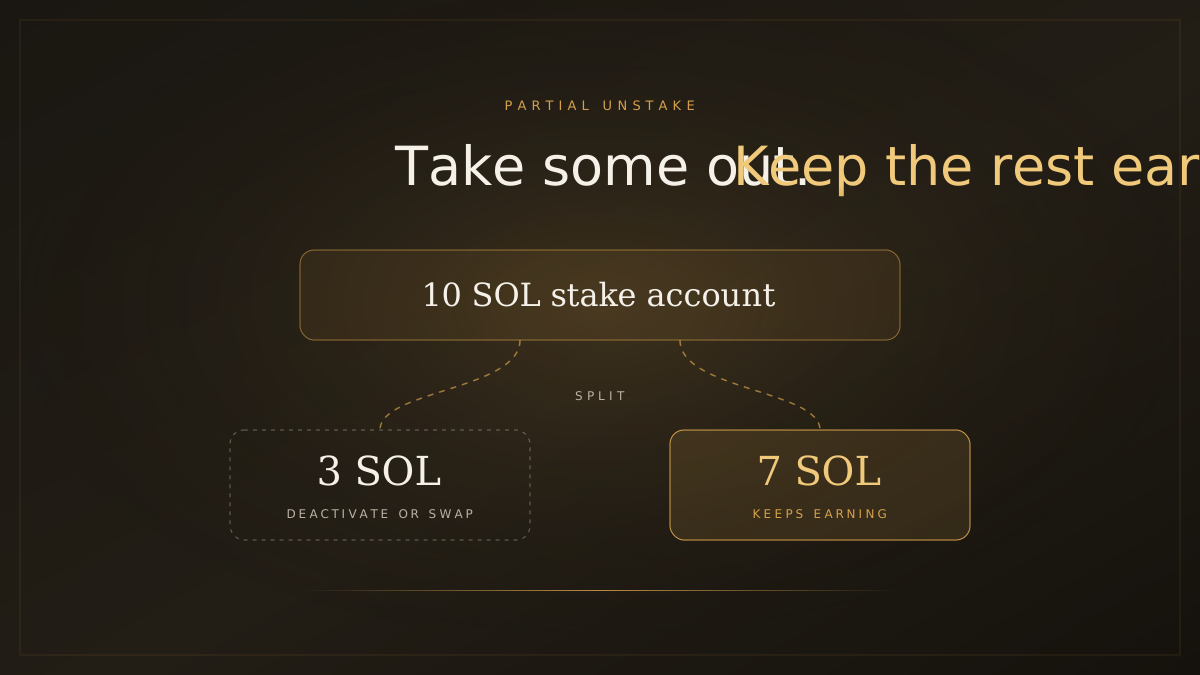
Partial Unstake on Solana: Take Part of Your Native Stake Out Without Ending It
You do not have to close a whole Solana stake account to get some SOL back. Split it, exit the slice, and let the rest keep earning. Here is how the split works, what it costs, and when each exit makes sense.
 Education
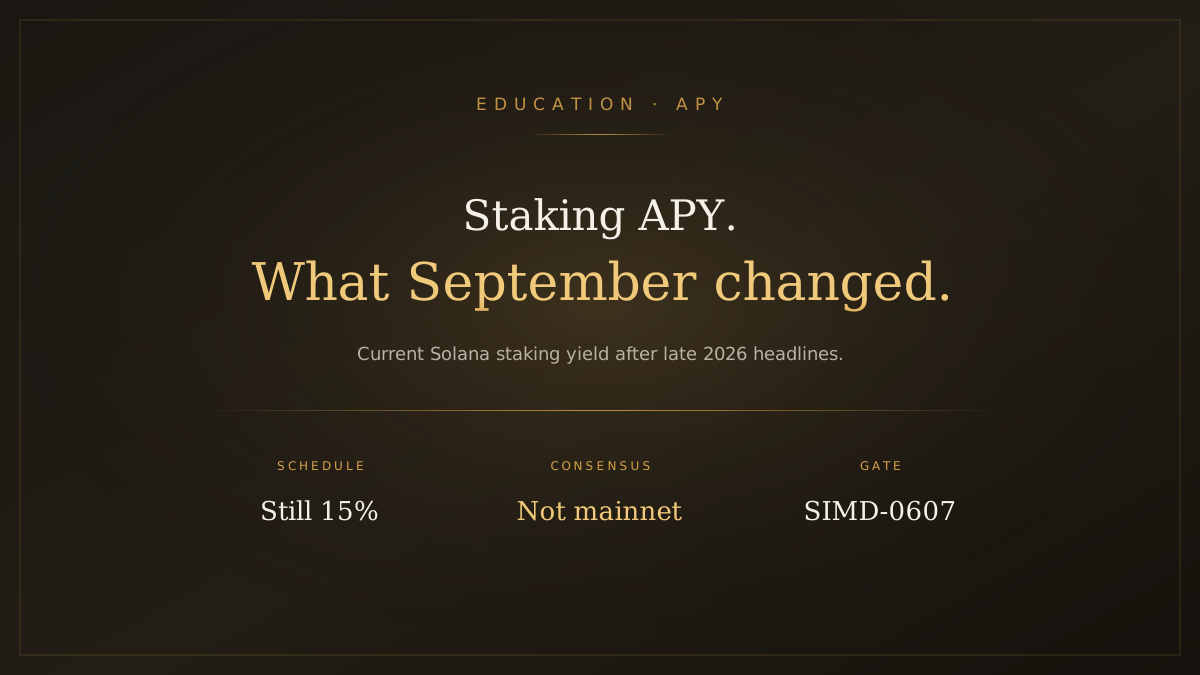
Current Solana Staking APY in Late 2026: What September Changed
Looking up current Solana staking APY after September? The number still tracks inflation minus commission, plus any routed MEV. Sept 28 did not flip mainnet Alpenglow, and faster disinflation is still gated.
 Education
How Solana Staking Rewards Work in 2026
Your epoch payout is inflation rewards minus commission, plus any block or MEV share your operator routes. Here is what actually hits a staker wallet in 2026, and what has not changed yet after SGP-0002.