
How to Choose a Solana Validator After Alpenglow: 7 Checks You Can Run Yourself
Picking a Solana validator used to mean commission plus a score. After Alpenglow there is a new way to miss an epoch's rewards, and some dashboards read the wrong field. Here are seven checks you can run yourself.
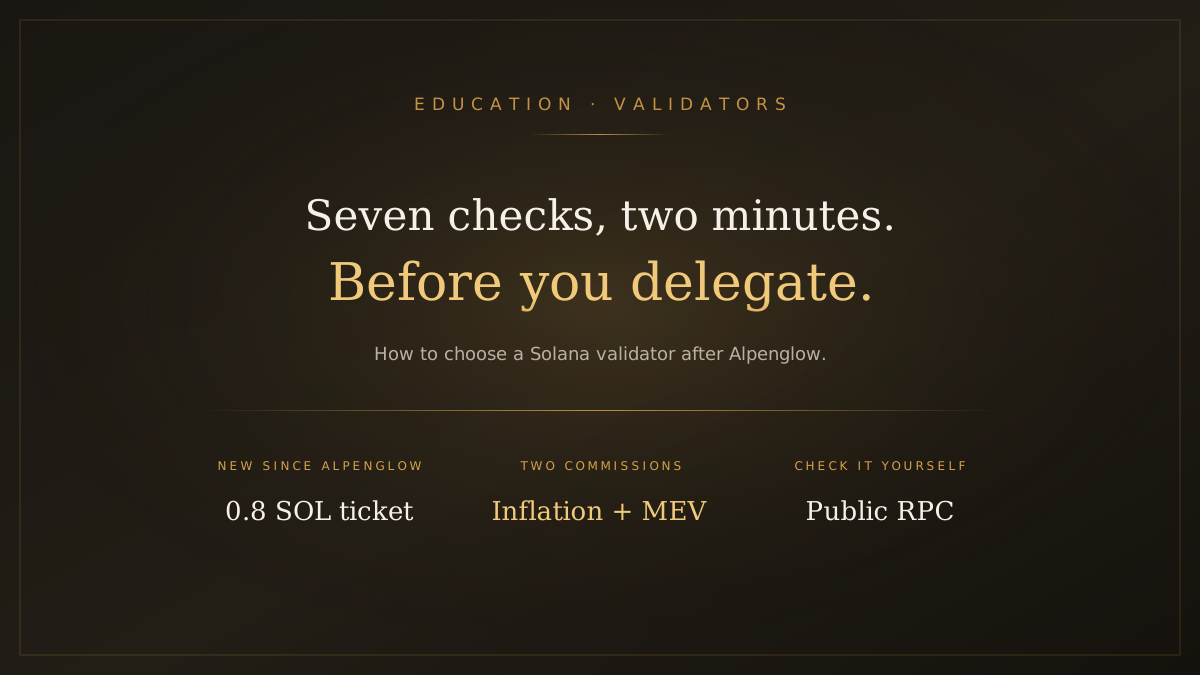
TL;DR. Choosing a Solana validator after Alpenglow comes down to seven checks you can run yourself: inflation commission, MEV commission, vote account funding for the new 0.8 SOL per-epoch admission ticket, delinquency, skip rate, stake concentration, and client plus identity. The new one is funding: a vote account that can't pay the ticket sits out the next epoch, and its delegators earn nothing for it. And watch out for old scoreboards, because one key field changed meaning.
If you searched how to choose a Solana validator this month, most guides still tell you to look at commission and a performance score. That advice is not wrong. It is just from before 21 October 2026, when Alpenglow took over mainnet.
As of 9 November 2026, epoch 1081.
What Alpenglow changed for delegators
Your stake still earns the same way: you delegate, it activates at the next epoch boundary, and rewards are paid per epoch. If you want the timing details, see Solana unstaking after Alpenglow.
What changed is what can go wrong on the validator side.
- Votes are no longer transactions. Under TowerBFT, voting cost a validator about 1 SOL per epoch in vote fees, per solana.com.
- A flat admission ticket replaced those fees. The Validator Admission Ticket (VAT, SIMD-0357) charges each voting validator 0.8 SOL per epoch, taken from the vote account and burned. The fee charged at the start of epoch N pays for epoch N+1.
- Miss the ticket, miss the epoch. If the vote account can't pay, the validator doesn't vote or produce blocks in the next epoch, and delegators get no protocol rewards for that epoch (solana.com, Everstake).
- One scoring field changed meaning.
epoch_creditsin a vote account now records reward lamports, including the leader's share. Tools that still read it as vote credits get it wrong (Everstake).
The 7 checks
| # | Check | What you want to see | Where to look |
|---|---|---|---|
| 1 | Inflation commission | A number you understand. Not 100%. | solana vote-account <VOTE> or any explorer |
| 2 | MEV commission | Published, and low enough for you | Jito's public validator API |
| 3 | Vote account funding | At least 0.8 SOL above rent-exempt | solana balance <VOTE> |
| 4 | Delinquency | Voting now, no recent gaps | solana validators, getVoteAccounts |
| 5 | Skip rate | Close to the network norm | solana block-production |
| 6 | Concentration | Not already in the superminority | getVoteAccounts, sorted by stake |
| 7 | Client and identity | Supported client, named operator | solana validators, operator site |
1. Inflation commission
Commission is the share of inflation rewards the validator keeps. It lives on the vote account, so it is public and you can read it before you delegate.
In our snapshot of staked, voting validators at 15:45 IST on 9 November 2026 (public mainnet RPC, getVoteAccounts):
| Commission | Validators |
|---|---|
| 5% | 265 |
| 0% | 221 |
| 100% | 63 |
| 10% | 33 |
A 100% setting means delegators get none of the inflation rewards. Those are usually private or foundation setups, not something a retail delegator should pick by accident.
Commission can also change. Check it again later, not just once.
2. MEV commission
On Jito-based validators, MEV tips are a second income stream with their own commission. It is separate from inflation commission, so a 0% inflation validator can still keep most of the MEV.
Jito publishes mev_commission_bps per validator per epoch:
https://kobe.mainnet.jito.network/api/v1/validators/<VOTE_ACCOUNT>
Read a few epochs, not one. You are looking for a steady setting.
3. Vote account funding (new since Alpenglow)
This is the check most older guides don't have.
The vote account has to hold 0.8 SOL above its rent-exempt minimum at the start of each epoch. For a standard 3,762-byte vote account, public mainnet RPC returned a rent-exempt minimum of 19,761,200 lamports (about 0.0198 SOL) on 9 November 2026. So the floor is roughly 0.82 SOL.
solana balance <VOTE_ACCOUNT>
A balance sitting right at the floor isn't a crisis, but it means one missed top-up could cost an epoch. Some operators route block revenue into the vote account so it refills each epoch, and solana.com notes that change takes two epochs to apply.
4. Delinquency and recent epochs
A delinquent validator has stopped voting. At our 15:45 IST snapshot on 9 November 2026, 34 vote accounts were delinquent, holding about 0.56 million SOL out of about 434 million SOL delegated.
Check that the validator is voting now, then look at its recent epochs for gaps:
solana vote-account <VOTE_ACCOUNT>
The epoch list should run without holes. A missing epoch means the validator earned nothing that epoch, and neither did its delegators. After Alpenglow the numbers in that list are reward lamports, so compare epochs to each other, not to old vote-credit leaderboards.
5. Skip rate
Skip rate is the share of a validator's leader slots that didn't produce a block. Everstake points out it is the only performance test in the Solana Foundation Delegation Program, and it feeds straight into rewards. Compare a validator to the network average over a few epochs, not to zero.
solana block-production --epoch <EPOCH>
6. Stake concentration
The superminority is the smallest group of validators that together hold more than a third of stake. In our 9 November snapshot that was 18 validators. Delegating outside that group spreads stake across more operators, which is good for the network you're staking on. Our validator concentration piece covers why one third matters.
7. Client and identity
Client versions move fast after an upgrade. As of epoch 1081, the Solana Foundation Delegation Program requires at least version 4.4.0 for the next few epochs. solana validators shows each validator's version, so you can see who has fallen behind.
Then check who runs it. A name, a website, a way to reach them, and a history you can look up. You are trusting this operator with your rewards for as long as you stay delegated.
Don't outsource the whole decision to a score
Scores are useful. They are also only as good as the fields they read. After Alpenglow, a dashboard that still treats epoch_credits as vote credits can rank validators wrong. Prefer tools that say they were rebuilt for Alpenglow, and run checks 1 to 3 yourself. They take two minutes.
How this applies to Hubra
Hubra runs one validator. Native stake through Hubra and raSOL both back that same validator, so you only have one operator to check.
You can run every check above on it:
| Field | Value (9 Nov 2026) | Source |
|---|---|---|
| Vote account | 7K8DVxtNJGnMtUY1CQJT5jcs8sFGSZTDiG7kowvFpECh | mainnet RPC |
| Inflation commission | 5% | getVoteAccounts |
| MEV commission | 0% | Jito kobe API |
That's the point of a single-validator design: one vote account, public settings, nothing hidden behind a pool you can't see into. Don't take our word for it. Paste the vote account into the commands above.
Still deciding between native stake and an LST? Native vs liquid staking covers the trade-offs.
 Education
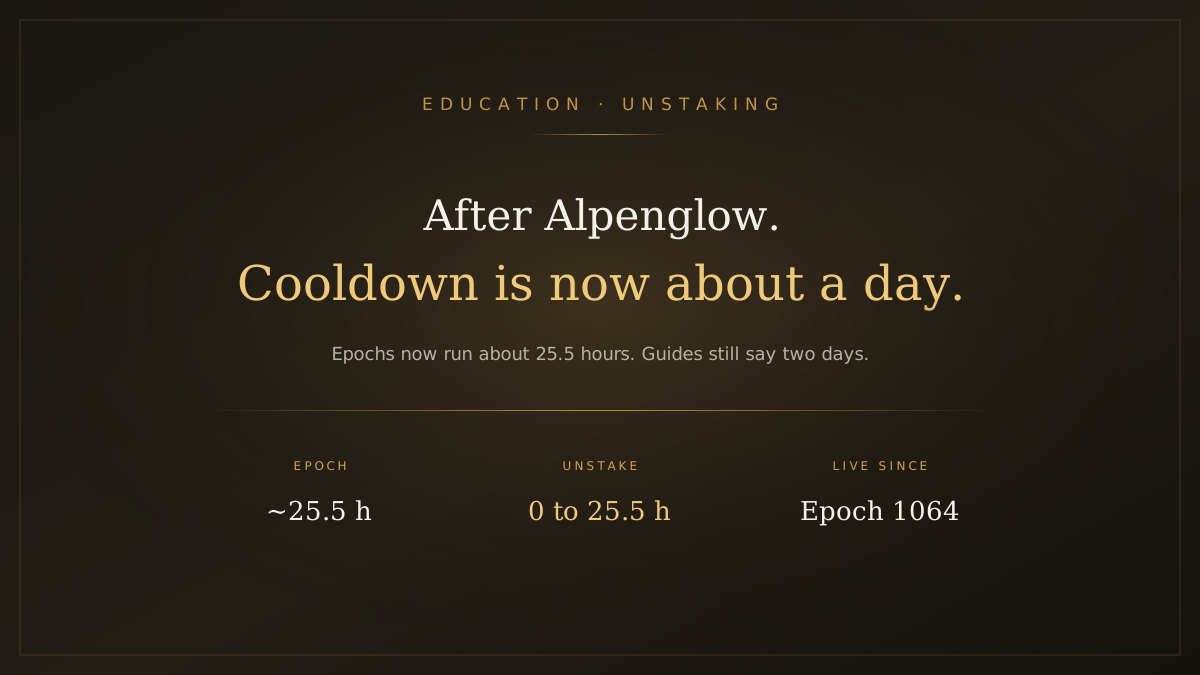
Solana Unstaking After Alpenglow: Cooldown Is Now About a Day
Alpenglow is live. Epochs now run about 25.5 hours, so a normal Solana unstake cooldown finishes at the next boundary somewhere between minutes and about a day. Most mainstream guides still say two days.
 Education
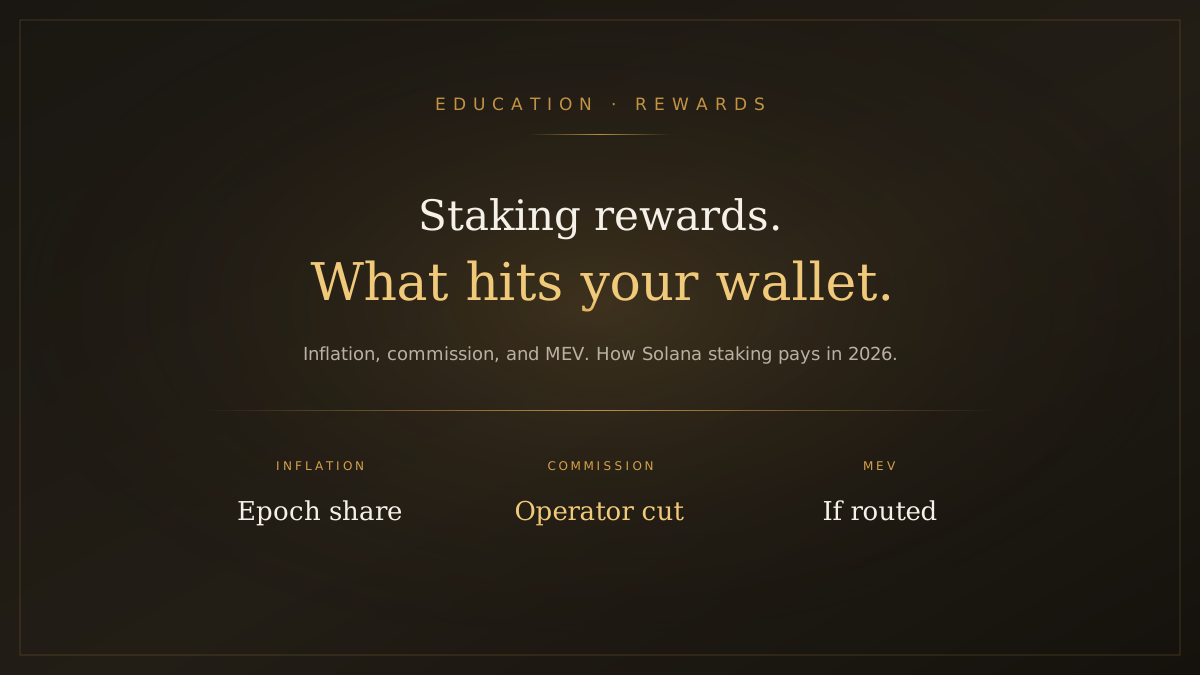
How Solana Staking Rewards Work in 2026
Your epoch payout is inflation rewards minus commission, plus any block or MEV share your operator routes. Here is what actually hits a staker wallet in 2026, and what has not changed yet after SGP-0002.
 Education
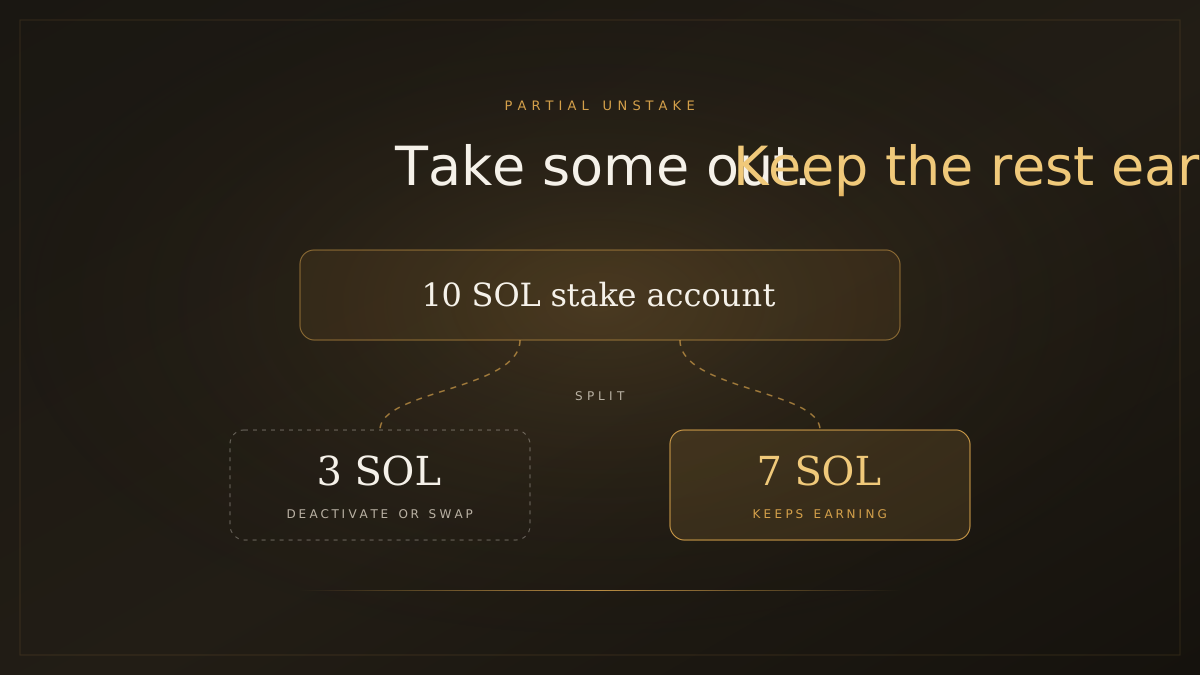
Partial Unstake on Solana: Take Part of Your Native Stake Out Without Ending It
You do not have to close a whole Solana stake account to get some SOL back. Split it, exit the slice, and let the rest keep earning. Here is how the split works, what it costs, and when each exit makes sense.