
Solana Validator Concentration Risk After the Near-Halt
One infrastructure failure pushed nearly 29% of Solana stake offline. Finality needs more than two thirds of stake voting. Here is what stakers should check now.
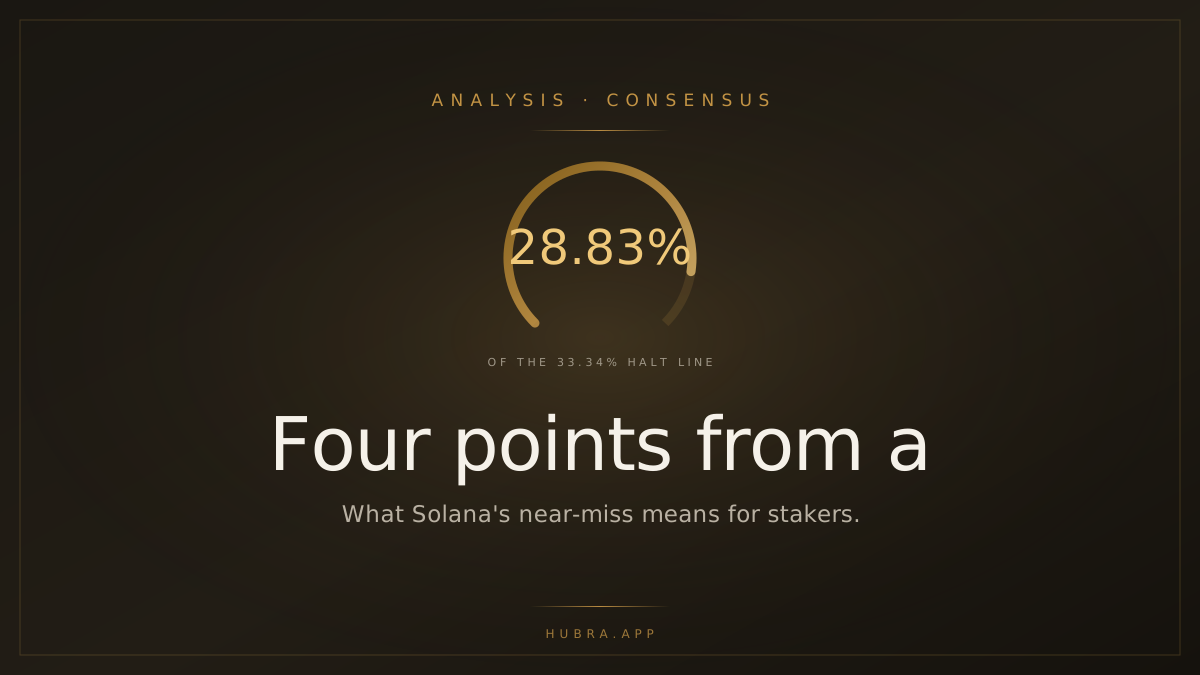
TL;DR. On August 12, 2026, a routing misconfiguration at one hosting provider took about 90 Solana validators offline at once. Marinade measured 28.83% of staked SOL as delinquent at the peak. Confirmation stops once delinquent stake reaches 33.34%, because the remainder can no longer clear a two-thirds supermajority, so the margin was 4.51 percentage points. Nothing was slashed, the chain never stopped, and the total cost to stakers was roughly 333 SOL. The lesson is not that Solana is fragile - the software behaved exactly as designed. It is that validator count is a bad proxy for diversification, and the number that actually matters is how much stake sits behind a single network.
Solana has not had a network-wide halt since February 2024, roughly 30 months. On Wednesday morning it came 86% of the way to the threshold where the network would have stopped confirming blocks, and almost nobody noticed.
There was no software bug, no consensus failure, no attack. A hosting provider propagated a malformed route out of its Miami site, and roughly a quarter of all staked SOL fell off the internet in the same minute. The chain kept producing blocks. It simply came closer than it has in two and a half years to being unable to agree on them.
For anyone with SOL delegated, this is the most useful incident of the year, because it exposes a risk that is measurable, currently unmanaged by most stakers, and fixable in about ten minutes.
What actually happened on August 12?
Teraswitch, a Pittsburgh-based hosting provider that a large share of Solana validators run on, uses an internal default route to signal that an edge router can reach the internet. Per the provider's own incident writeup, a default route from its Miami site was propagated with its metric and BGP communities stripped. A route reflector in Amsterdam then distributed that route across Europe and Asia-Pacific.
Edge routers in those regions read the stripped route as locally originated and preferred it over their real one. They passed it to the data center core, which correctly rejected it as invalid. The result was twelve sites - across London, Amsterdam, Dublin, Frankfurt, Singapore and Tokyo - with no valid path to forward traffic to. North American sites were unaffected.
Engineers identified the fault within about ten minutes and traffic was restored at 04:16:15 UTC. Some validators were down for roughly 33 minutes.
The measurements of what that did to consensus come mainly from Marinade Finance, which pulled the numbers afterwards:
| Metric | Value |
|---|---|
| Peak delinquent stake | 28.83% |
| Finality threshold | 33.34% |
| Headroom | 4.51 percentage points, roughly 19.6M SOL |
| Validators affected | ~90 (Marinade) |
| Total rewards missed | ~333 SOL |
| Downtime for affected validators | ~33 minutes; some reporting says up to ~40 |
One number is worth flagging as contested. Marinade counted about 90 affected validators. Jacob Creech of the Solana Foundation said 597 of 699 staked validators kept voting, which implies 102 stopped. These are two different measurements taken slightly differently rather than a contradiction, but if you see both figures quoted, that is why.
Why 33.34% is the number that matters
This is the part worth understanding properly, because it applies every day and not just during incidents.
Solana confirms a block when more than two thirds of active stake has voted for it. Finality follows once a run of further blocks is confirmed on top. Two thirds is the standard Byzantine fault tolerance boundary: you can lose just under a third of the network and still form a supermajority among what remains.
So 33.34% is not a constant written into the protocol. It is the leftover: the largest share of stake that can go silent while everything still voting continues to clear two thirds.
Cross that line and the remaining validators mathematically cannot reach two thirds. Blocks may still be produced, but nothing gets confirmed and nothing gets finalized.
| Delinquent stake | What happens |
|---|---|
| Under 33.34% | Normal. Confirmation and finality proceed. Offline validators miss rewards. |
| At or above 33.34% | No supermajority. Confirmation stops. Nothing finalizes for anyone. |
| Recovery | Automatic once validators return, provided the chain did not halt outright. |
The distinction between a stall and a halt is not academic. A stall resolves itself when connectivity returns, which is what would have happened here. Solana's last outright halt, in February 2024, required validators to coordinate a manual restart that took close to five hours. No bond covers that, and no staker can do anything about it while it is happening.
Worth noting: several Anza engineers pointed out that Devnet did halt during the same fault and recovered on its own, and that the same event two years ago would likely have taken mainnet down. The consensus software passed this test. The physical infrastructure underneath it is what got exposed.
How did one provider end up with a quarter of Solana's stake?
Slowly, and without anyone deciding to.
Teraswitch operates autonomous system AS20326. An ASN identifies one provider's network. Validators sitting behind the same ASN can be in different cities, different data centers and run by completely unrelated operators, and still share a single routing fate.
At the time of the incident, AS20326 carried 118,890,767 SOL. Against roughly 435 million SOL staked network-wide, that is about 27.34% of everything staked on Solana. Around 94% of it went offline simultaneously.
The concentration also ran wider than one provider. Marinade found a further 14.1 million SOL going delinquent in the same minutes across latitude.sh, Limestone, Butterfly Research and Allnodes, and said it could not determine from the data whether that reflected a shared dependency or coincidence. Either answer is uncomfortable: counting stake by hosting provider may understate what actually fails together.
The knock-on effects reached past validators too. The Pyth oracle degraded during the same window because two of its four NATS nodes were hosted at Teraswitch, costing it quorum.
Did anyone fail over?
This is the finding stakers should sit with longest.
Of 74 operators Marinade could measure, three came back cleanly: Laine, Cogent Crypto and Lion3d. Laine and Cogent Crypto are both run by Sol Strategies, so that is really two independent operators out of 74.
Fifty-nine validators holding 80.2 million SOL came back inside the same narrow window in Amsterdam, Frankfurt and Tokyo. They did not fail over to anything. They waited for the routing to reconverge. Helius, the second-largest validator on Solana, was down for the full 33 minutes.
Automatic failover and hot-swap capability are not visible from outside a validator today. You cannot check whether the operator you delegate to has a standby. Marinade said it would start publishing that status, which would be the single most useful new disclosure in Solana staking if it lands.
What the rules already said
The Solana Foundation Delegation Program, which delegates Foundation stake to qualifying validators, tightened its concentration criteria effective May 1, 2026:
| SFDP criterion | Limit | Network-wide on August 12 |
|---|---|---|
| Stake behind one ASN and hosting provider | Less than 25% | AS20326 at 27.34% |
| Data center concentration | Not above 15% | Not published per-site |
Read that table carefully, because the two columns do not measure the same population. Network-wide concentration was already past the Foundation's 25% threshold on August 12, but that threshold is a qualifying criterion for validators receiving Foundation-delegated stake. It does not cap the network, and the Foundation has no mechanism to make it do so. That is a limitation of scope rather than a failure of the rule. Creech noted that SFDP validators were unaffected by the outage, which suggests the criteria worked for the cohort they cover.
The gap is that most staked SOL is not SFDP stake. It is delegated by individuals, pools and institutions who chose validators on commission, uptime and MEV performance - and essentially never on ASN.
Marinade audited itself on the same basis and published the result: four ASNs hold two thirds of the stake its allocation model distributes, with AS395201 alone at 36.94%. Its own comment was that nobody should be comfortable with that, itself included. That is the right response, and it is a standard worth holding other pools to.
What did it actually cost stakers?
Very little, this time. About 333 SOL in missed rewards across roughly 90 validators, which reporting indicates validator bonds are expected to cover at the end of the epoch.
Put that in proportion. Roughly 435 million SOL is staked, about 69% of supply, earning somewhere around 5.2% to 5.3% nominal before MEV tips. A 33 minute outage on a quarter of the network cost the equivalent of a rounding error, because Solana does not slash stake for ordinary downtime. Downtime costs you yield, not principal. If that mechanic is new to you, staking mechanics covers how epochs, vote credits and rewards fit together.
The counterfactual is the point. Had delinquency crossed a third, nothing would have finalized for any SOL holder anywhere - not just for stakers behind the affected provider. Concentration risk is not something you carry alone. Everyone holds it, and it does not show up in any APY figure.
What stakers should do now
1. Look up your validator's ASN. Two minutes on validators.app, Stakewiz or Solana Compass will tell you the autonomous system and data center behind the vote account you delegate to. Most stakers have never checked this. It is the single most informative field about your validator that is not on any leaderboard.
2. Diversify by network, not by name. Splitting a position across five validators that all sit behind AS20326 achieves nothing. Splitting across two validators on genuinely different ASNs in different regions achieves most of what is available to you. If you are running native delegation, native staking on Hubra lets you spread across multiple validators without re-learning the CLI each time.
3. Ask your pool how it measures diversity. If you hold an LST, your delegation decision has been outsourced. Marinade's self-audit set a useful precedent by publishing per-ASN concentration; the reasonable question for any pool is whether it caps by ASN and data center or only by validator count. Our liquid staking guide and native versus liquid comparison cover the tradeoff, and /liquid-stake is where to go if you want the pool to handle it.
4. Do not overreact on price. Nothing about this incident changes Solana's reward mechanics, issuance schedule or roadmap. The consensus layer did its job. Treat it as an infrastructure disclosure, not a thesis change.
5. Keep the Alpenglow context in mind. The consensus switch expected around October 2026 takes finality from roughly 12.8 seconds to a target near 150 milliseconds, and lowers the profitable-validator stake floor substantially, which should widen the operator set over time. It does not fix hosting concentration. Faster finality on the same twelve data centers is still the same twelve data centers. Our Alpenglow explainer and the Validator Admission Ticket piece cover what is actually changing.
The honest summary of August 12 is that Solana worked. Roughly 29% of stake vanished for half an hour and the chain carried on producing and confirming blocks, which is precisely what the protocol is designed to do. The uncomfortable part is that the margin was 4.51 points, the cause was one router in Miami, and the fix is not a protocol upgrade. It is thousands of individual delegation decisions that currently ignore the one variable that mattered here.
Sources
The figures here come from four places, and they do not all measure the same thing:
- Marinade Finance's incident analysis - peak delinquent stake (28.83%), affected validator count (~90), missed rewards (~333 SOL), per-ASN stake, operator recovery behavior, and Marinade's audit of its own allocation model. Posted on X.
- Teraswitch's incident writeup - the routing sequence, the twelve affected sites, and the 04:16:15 UTC restoration time.
- Jacob Creech, Solana Foundation - the 597 of 699 staked validators still voting, and that SFDP validators were unaffected.
- Solana Foundation delegation criteria - the ASN and data center concentration limits effective May 1, 2026. solana.org/delegation-criteria.
Two numbers in this piece are often quoted as if interchangeable and are not. 27.34% is the share of staked SOL sitting behind AS20326. 28.83% is the peak share of stake that stopped voting during the incident, which includes validators at other providers. Where sources conflict, as with the affected-validator count, both figures are given rather than reconciled.
This article is for information only and is not financial advice.
 Analysis
Why Solana Staking Yields Have Not Changed After SGP-0002
SGP-0002 passed by 0.334 points. Your next epoch payout did not move. Faster disinflation is gated on SIMD-0607, client releases, and a feature gate with no public activation date.
 Analysis
Solana's First Governance Vote: What SGP-0001, 0002, and 0003 Mean for Stakers
Three proposals. Two passed. One failed. Solana's first on-chain governance vote set the rules, sped up disinflation, and left fee burns for another day. Here is the staker briefing.
 Analysis
Alpenglow: Solana's new consensus, in plain English
Alpenglow is the biggest change to Solana since the chain went live. Confirmations that feel instant, a calmer chain under the hood, and a new validator fee called the VAT that's designed to keep economics flat, not to raise your staking yield. Here's what it means in plain English.