
How Solana Stakers Vote and Override Their Validator
For the first time, Solana stakers can vote on network decisions and override their validator. Here is what changed in June 2026 and how to use your stake.
TL;DR. On June 18, 2026, Solana switched on on-chain governance tooling that lets stakers vote directly - and override their validator - for the first time. Proposals now split into two tracks: routine technical changes (SIMDs) that pass quietly, and strategic or economic decisions (SGPs) that need a full network vote. The first proposal, SGP1, ratifies the rulebook itself. The first economic fight, SIMD-0550 on disinflation, has been waiting for exactly this. If you stake SOL, your stake is now your ballot.
For years, Solana stakers had no real vote. You delegated your SOL, your validator voted on network decisions, and that was the end of it. If your validator voted in a way you disagreed with, you had no way to say so without unstaking and moving.
That changed in June 2026. Solana turned on new on-chain governance tooling, and for the first time, the roughly 1.2 million people staking SOL can vote on proposals themselves - and override their validator when they want to.
This guide explains what went live, how the new system works, and what you should actually do as a staker. Nothing here has finished a vote yet, so this is about understanding the machine before the first big decisions run through it.
Solana stakers can finally vote
The headline is simple. On June 18, 2026, Solana's on-chain governance tooling went live on mainnet. Anyone can now create a proposal, and once a vote opens, stakers participate directly.
The most important part for you: you can override your validator's vote, or vote even if your validator does not vote at all. Validators are still the default steward for the stake delegated to them, but they are no longer the only voice. The delegator finally has an independent one.
That sounds like a small mechanical change. It is not. It reshapes who actually decides Solana's economic policy - including the policies that set your staking yield.
Why this matters: the SIMD-228 problem
To see why this is a big deal, look at what happened the last time Solana tried to change its core economics.
In March 2025, an inflation proposal called SIMD-0228 went to a validator vote. It drew about 61% support - and failed, because changing economics requires a two-thirds supermajority (about 66.7%). It came up short by a few percentage points.
Here is the catch that exposed the gap: validators cast those votes on behalf of their delegators, who had no way to vote for themselves. More than a million stakers were directly affected by the outcome and had no independent say in it. Whatever your validator decided was decided for you.
The new governance system is the fix for exactly that gap. It gives the stake itself a vote, not just the operator running the machine.
The new system: two tracks
The new model splits proposals into two clearly separated types. This matters because it decides when something goes to a vote at all.
| Type | What it covers | How it passes |
|---|---|---|
| SIMD (Solana Improvement Document) | Technical protocol changes | Optimistic - passes without a vote unless it is elevated |
| SGP (Solana Governance Proposal) | Strategic and economic decisions | Always requires a full network vote |
The logic is that most engineering work does not need a network-wide referendum. A SIMD can move through optimistically. But anything that touches money, policy, or the rules of the game - an SGP - has to face a vote where stake decides the outcome.
A SIMD can still be elevated into a full vote if validators sponsoring 15% of stake demand it. That is the escape hatch that stops a contentious economic change from sliding through as a quiet technical one.
Your stake is your ballot: the delegator override
This is the feature that changes things for you specifically.
When a vote opens, the network takes a snapshot of every stake account at a fixed point in time. To vote, you submit a cryptographic receipt (a Merkle proof) showing how much stake you control, and the vote is weighted by that stake. All of the verification happens on-chain, so no one has to trust an operator to count correctly.
Two things follow from that design:
- You can override your validator. If your validator votes one way and you disagree, your own vote takes priority for your stake.
- You can vote even if your validator does not. Apathy at the validator level no longer silences your stake.
The plumbing behind this was built as a dedicated stake-snapshot network (by Exo Technologies) plus a separate voting program (by Turbin3), deliberately kept apart so each can be audited on its own. You do not need to know any of that to vote. You just need to know that the override exists and that it follows your stake.
How a proposal becomes law
The lifecycle of an SGP runs through a few stages. The exact numbers below come from the draft Solana Constitution (version 5.0), and they are not final - ratifying them is literally the job of the first proposal (more on that next). Treat them as the proposed shape of the process, not settled law.
| Stage | Proposed parameter |
|---|---|
| Sponsor threshold | 15% of stake to elevate a proposal to a vote |
| Discussion period | About 10 epochs (roughly 20 days) |
| Voting period | About 3 epochs (roughly 6 days) |
| Quorum | At least 1/3 of stake must participate |
| Pass threshold | 2/3 supermajority of participating stake |
The 15% sponsor threshold is the spam filter. Anyone can write a proposal, but it has to attract real backing before the whole network is asked to vote on it. After that, there is a fixed window to discuss, then a fixed window to vote, and a proposal only passes if enough stake shows up (quorum) and a two-thirds supermajority agrees.
SGP1: voting on the rules themselves
The first proposal expected through the new tooling is SGP1, the Solana Constitution.
This is meta-governance: SGP1 does not change a fee or an emission rate. It defines how governance itself works - the thresholds, the discussion periods, the voting flow, and the principle that stakers can override their validators. It is both a live test of the new tooling and a formal statement of how Solana intends to make decisions going forward.
In other words, the network's first real vote is a vote on how it will vote. Once SGP1 clears the 15% sponsor threshold, it enters its discussion period before any ballot opens. As of late June 2026, the tooling is live and the first proposals are entering the pipeline. No network vote has finished yet.
The first real test: SIMD-0550 and your yield
The reason this is not an abstract governance story is SIMD-0550.
SIMD-0550 is a live proposal to double Solana's disinflation rate from 15% to 30% per year. It would not change where inflation starts or where it ends, only how fast it gets there - pushing the network to its 1.5% terminal floor years sooner, and cutting nominal staking yield faster along the way. By the proposal's own modeling, that is roughly 4.34% in year one versus 4.93% under the current schedule, with a wider gap after.
Here is the connection: SIMD-0550 has explicitly been waiting for this governance tooling to exist before it can go to a formal vote. The mechanism that just went live is the same mechanism that will decide whether your staking yield gets cut sooner. That is no longer a decision made entirely above your head - if it reaches a ballot, your stake can vote on it.
We break down the full numbers, the timeline, and the validator impact in Solana staking rewards and disinflation. For this guide, the point is narrower: the new governance is the room where that fight now happens.
If you hold an LST, who votes your stake?
This is the part most stakers will miss, and it is worth getting right before the first big vote.
The override follows the stake account's withdraw authority - the key that ultimately controls the stake.
- Native staking: that key is yours. The vote, and the override, are yours to use directly.
- Liquid staking tokens and pools: the voting wallet is generally assigned to the operator. For standard stake pools the pool manager holds it; Marinade uses a dedicated operations key; some pools are counted directly under the validators they delegate to. In those cases the operator casts the governance vote for that stake, not you.
That is not a reason to avoid liquid staking - the tradeoffs between native and liquid staking are about custody, liquidity, and composability, and governance is one more line in that comparison. But if having a direct, independent vote matters to you, know that native staking is where the override lives today. How each LST provider handles vote pass-through may change as the system matures, so check your provider before you assume.
What stakers should do now
You do not need to do anything this minute. No vote has concluded, and nothing about your stake or rewards has changed yet. But this is the moment to get set up, because the decisions coming through this pipeline are the ones that move yields.
- Know that you now have a vote. The single biggest change is that your stake is no longer voiceless. Treat it like the asset it is.
- Understand the override. If you stake natively, you can vote against your validator. If you use an LST or a pool, find out who votes on your behalf.
- Watch SIMD-0550. It is the first economic proposal lined up for this system, and it directly affects your staking yield.
- Look at total return, not just headline APY. Lower issuance can support the SOL price even as nominal yield falls, so a yield cut is not automatically bad for holders.
- Stay flexible. As these debates play out, the ability to move between native staking and liquid staking without unwinding everything is worth keeping.
Governance participation is low across most networks, and Solana's designers know it. Validators will carry outsized influence unless stakers actually show up. The tooling now exists. Whether it changes anything depends on whether stakers use it.
Bottom line
For most of Solana's life, staking was a one-way relationship: you delegated, your validator decided, you lived with it. As of June 2026, that is no longer true. Stakers can vote, and they can override the validators voting for them.
The first proposals are modest on the surface - a constitution that sets the rules, and a disinflation change that has been debated for over a year. But the shift underneath is real. The people who hold the stake now hold a vote. If you stake SOL, the most useful thing you can do is understand that vote before the decisions that matter run through it.
With Hubra, you can stake SOL and keep your position liquid and non-custodial, with your keys in your wallet at every step - so you stay in control of both your yield and, increasingly, your voice.
On chain since 2020. Never a day down.
Ready to put your SOL to work? Stake on Hubra →
Sources: Solana Constitution draft (V5.0) and the governance framework presented at Breakpoint 2025; Exo Technologies, "Building Decentralized Governance for Solana" (Snapshot NCN design, stake-weighted voting, and delegator override); Chainflow's Solana validator discussion summaries (June 2026 Foundation call, governance tooling launch, SGP1); Solana Compass and the Solana Developer Forums for SIMD-0550. Governance parameters are drawn from the draft Constitution and are not final until ratified. Figures reflect the state of Solana governance as of late June 2026 and can change.
This article is for educational purposes only and is not financial advice. Always do your own research before staking.
 Education
Solana Block Rewards for Stakers: What SIMD-123 Changes
Solana staking yield is being rebuilt. SIMD-123 routes block rewards to stakers, SIMD-550 cuts inflation faster, SIMD-553 burns fees. What it means for you.
 Education
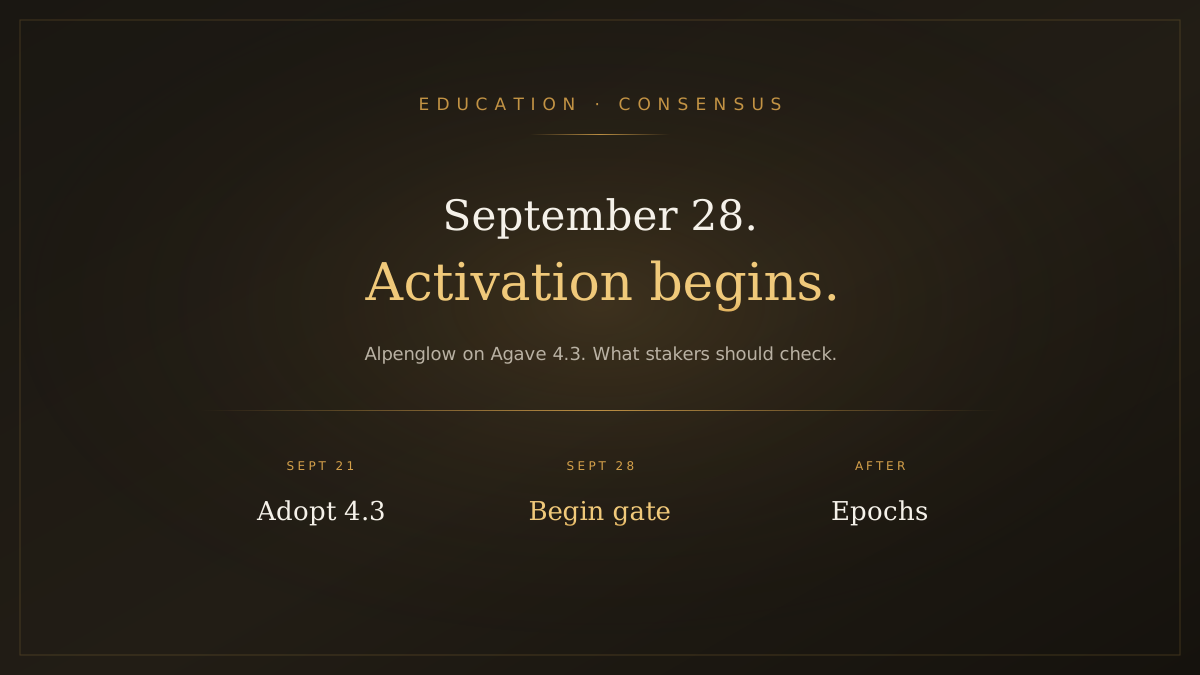
Solana Alpenglow Activation: What Stakers Should Check Before September 28
Alpenglow now has a provisional mainnet runway on Agave 4.3: general adoption September 21, begin feature activation September 28. A short checklist for stakers, not a republish of our earlier explainers.
 Education
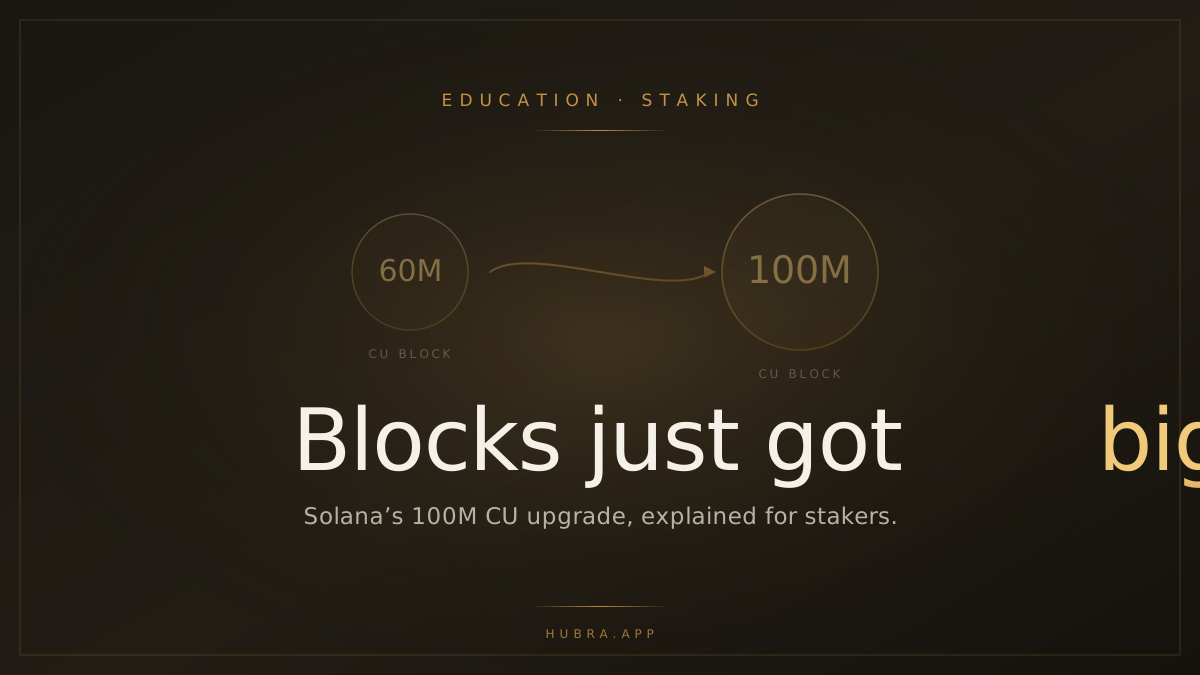
Solana's 100M CU Blocks: What Stakers Need to Know
Solana blocks just got 66% bigger. SIMD-0286 raised the compute limit to 100M CUs on July 29. Here is why more blockspace quietly matters for staking yield.