
Solana Block Rewards for Stakers: What SIMD-123 Changes
Solana staking yield is being rebuilt. SIMD-123 routes block rewards to stakers, SIMD-550 cuts inflation faster, SIMD-553 burns fees. What it means for you.
TL;DR. Solana is rebuilding where staking yield comes from. SIMD-123, accepted in March 2025 and, per Anza CEO Brennan Watt, now nearly code complete, will let validators distribute block revenue, today mostly priority fees, to their stakers in protocol for the first time. At the same time, SIMD-550 would cut inflation rewards faster and SIMD-553 would burn a resource fee on every transaction. Anza's CEO says all three should ship in 2026. Less printed yield, more real yield, and a validator's block-reward commission becomes a number every staker needs to watch.
If you stake SOL, your yield today is mostly newly printed tokens. The network mints roughly 60,000 SOL per day in staking emissions at current parameters, while burning only around 650 SOL/day recently, a figure that circulated widely this month after treasury firm DeFi Development Corp broke down the supply math. Three protocol changes now moving through Solana's pipeline would rework that picture from both ends: less new SOL printed, more real fee revenue flowing to stakers, and more SOL burned.
This guide covers the one closest to shipping, SIMD-123, and how it fits with the other two. On June 20, Anza CEO Brennan Watt said all three will get done this year, the first time the client team's leadership has grouped them into a single delivery window.
Why don't stakers earn block rewards today?
When a Solana validator produces a block, it collects the block's rewards, which since early 2025 include 100% of priority fees. That was SIMD-96: passed by validators in May 2024 and activated in February 2025, it stopped burning half of priority fees and gave the full amount to the block leader. This is about priority fees, the extra amount users add to jump the queue, not Jito's MEV tips, which are paid separately and stay outside the protocol.
Stakers got nothing from that change. Your delegated stake determines a validator's leader schedule weight, but the core protocol has never had a way to route any block revenue back to the stake that earned it. Delegators earn inflation rewards, minus the validator's commission, and that is it.
The gap got filled off protocol. Jito's tip distribution shares MEV tips with stakers and powers much of the yield behind liquid staking tokens. Some validators airdrop rewards manually or issue their own tokens. All of these depend on trust in the operator, and none of them are visible or enforced at the protocol level. Native stakers who simply delegate to a validator have been left out of block revenue entirely.
What is SIMD-123?
SIMD-123, formally called Block Revenue Distribution, adds the missing mechanism to the protocol itself. It passed a validator governance vote in March 2025 with 74.91% of participating stake in favor, on about 57% turnout.
Once active, it works like this:
- Validators set a block-reward commission on their vote account, in basis points, separate from their existing inflation commission.
- The protocol splits block revenue at that commission rate. The validator's share goes to a collector account of its choosing, which can be a multisig, a cold wallet, or a custom program.
- The remainder is distributed automatically to the validator's delegated stake accounts at the end of each epoch, through the same partitioned rewards mechanism that pays inflation rewards today.
Two details matter for stakers. First, sharing is opt-in: the default block-reward commission is 100%, so a validator that does nothing keeps all of its block revenue, exactly as today. Second, distribution is automatic once a validator opts in. You do not claim anything, and you do not sign up. The rewards land on your stake account at the epoch boundary.
The practical effect is that a validator's block-reward commission becomes a second headline number, next to the inflation commission you already compare. A validator advertising 0% commission on inflation rewards while keeping 100% of block revenue is telling you less than half the story.
It is worth being clear about what SIMD-123 does not do. It does not create new rewards or make staking APY jump overnight. It changes how existing validator revenue can be distributed. Validators still choose their block-reward commission, most block revenue is still priority fees, and Jito's MEV tips remain outside the protocol. The proposal makes revenue sharing transparent and standardized, rather than conjuring extra yield out of thin air.
When does SIMD-123 go live?
There is no confirmed date, but the signals are unusually specific. Watt said on June 20 that the implementation is almost code complete. It is slated for the Agave 4.1 client release, and activation would then happen through a feature gate at an epoch boundary once the implementation clears review.
Agave 4.1 is expected to include additional readiness work for Alpenglow, Solana's new consensus protocol, which has been running on a community test cluster since May 2026. That puts SIMD-123 in the middle of the busiest upgrade window Solana has had, and timelines can slip. Treat "ships in 2026" as a stated intention from the client team, not a guarantee.
How SIMD-550 and SIMD-553 fit in
SIMD-123 grows the real-revenue side of staking yield. The other two proposals shrink the printed side and the circulating supply:
| Proposal | What it changes | Status | Effect on stakers |
|---|---|---|---|
| SIMD-123 | Routes post-commission block revenue to stake accounts each epoch | Passed March 2025, almost code complete | Adds real fee income to staking yield, if your validator opts in |
| SIMD-550 | Doubles disinflation from 15% to 30% per year | Concept ACK from Anza, no vote scheduled | Cuts inflation-based yield faster, toward the 1.5% floor by ~H1 2029 |
| SIMD-553 | Splits the base fee and burns a resource fee tied to requested compute | Concept ACK from Anza, no vote scheduled | No direct yield change, but burns rise from ~650 to an estimated 7,500 to 9,000 SOL per day under the proposal's assumptions |
SIMD-550, filed on June 2 by Helius researchers, keeps the 8% starting point and the 1.5% floor but doubles the speed of travel between them. By the proposal's own projections at 68% staking participation, baseline inflation-only yield would fall to about 4.34% in year one versus 4.93% under the current schedule, and to about 3.00% versus 4.17% by year two. Roughly 18.9 million SOL of future issuance, worth about $1.5 billion at mid-2026 prices, would never be minted. We cover the full mechanics in our Solana staking rewards and disinflation guide.
SIMD-553, filed on June 4 by a pseudonymous Agave contributor, targets a quirk in the fee market: transactions pay the same base fee whether they request 10,000 compute units or 1.4 million. The proposal splits today's 5,000-lamport signature fee into a 2,500-lamport inclusion fee paid to the leader plus a resource fee of 0.5 lamports per requested compute unit, burned in full. Watt has confirmed it supersedes the earlier SIMD-547 discussion.
DeFi Development Corp's framing is that the three together could push net new issuance toward zero. That is the optimistic long-run case, and it deserves a caveat: in the near term, roughly 60,000 SOL minted per day against a projected 7,500 to 9,000 burned still leaves large net issuance. The honest version is direction, not destination: meaningfully less net new SOL, and a larger share of staker income coming from real economic activity.
What does this mean for your staking yield?
Put the three together and the composition of staking yield changes shape:
| Yield source | Today | After the rebuild |
|---|---|---|
| Inflation rewards | Nearly all of native staking yield | Smaller and shrinking faster if SIMD-550 passes |
| Priority fees and block revenue | Zero in protocol for native stakers | Shared at each validator's block-reward commission under SIMD-123 |
| MEV tips | Off-protocol only, mostly via Jito and LSTs | Still off protocol, but no longer the only route to real revenue |
Three practical consequences follow.
Validator choice matters more. Today, comparing validators mostly means comparing inflation commission and performance. Once SIMD-123 activates, the block-reward commission becomes a real yield variable, and it will differ far more between validators than inflation commission does.
Real yield replaces printed yield slowly, not instantly. Priority fee income scales with network activity. In busy periods the shared block revenue could be meaningful; in quiet ones it will not offset the inflation decline. During the SIMD-123 vote, some validators estimated the staker-side boost at up to roughly one extra percentage point of APY. Treat that as a ceiling estimate from one side of the debate, not a promise.
The validator set may consolidate. The loudest objection during the vote was that stake pools will pressure validators to cut block-reward commissions toward zero, squeezing small operators who already run at thin margins. Supporters counter that stakers were already demanding block revenue through off-protocol deals, and that an in-protocol standard is more transparent than the side arrangements it replaces. Both can be true, and how it plays out will shape validator economics for years.
Who decides, and when?
SIMD-550 and SIMD-553 still need governance votes, and no dates are scheduled. What changed this month is how those votes will work. On July 1, Solana switched on its on-chain governance system. Opening a proposal requires 100,000 SOL staked to the initiating validator, proposals need support from 15% of active stake to advance, and passage takes a two-thirds supermajority of voting stake.
Most importantly for readers of this blog: stakers can now vote directly and override their validator's vote. If SIMD-550's yield cut or SIMD-553's fee change goes to a ballot, your stake is your voice. We explain the mechanics, including how override works for native stakers versus LST holders, in our guide to Solana governance and staker voting.
What stakers should do now
Nothing here requires action today, but the direction is clear and worth positioning for.
- Know both commissions. When SIMD-123 activates, check your validator's block-reward commission, not just the inflation commission. A low headline commission with 100% block-reward retention is the new fine print.
- Expect headline APY to drift down. The inflation share of yield is designed to shrink, and SIMD-550 would accelerate it. Judge your position on total return, including fee income and reduced dilution, not on the sticker rate. Our staking mechanics guide explains how the pieces combine.
- Understand your route to real revenue. Liquid staking tokens already capture tips through operators like Jito; SIMD-123 finally gives native staking its own in-protocol path. That narrows one of liquid staking's historical yield advantages, though liquid staking still offers instant liquidity and DeFi composability that native staking does not. It shifts the native versus liquid staking trade-off for holders who value simple custody over flexibility.
- Use your vote. Governance is live, and the next yield decision will be made by staked SOL. If you have not staked yet, our guide to staking SOL covers every route, or you can start with liquid staking to stay flexible.
Hubra tracks your staking positions and yields in one place, so when block rewards start landing on stake accounts, you will see exactly what your validator is passing through.
This article is for educational purposes only and is not financial advice. Proposals, dates, and figures reflect Solana governance as of July 6, 2026 and can change. Always do your own research before staking.
 Education
How Solana Stakers Vote and Override Their Validator
For the first time, Solana stakers can vote on network decisions and override their validator. Here is what changed in June 2026 and how to use your stake.
 Education
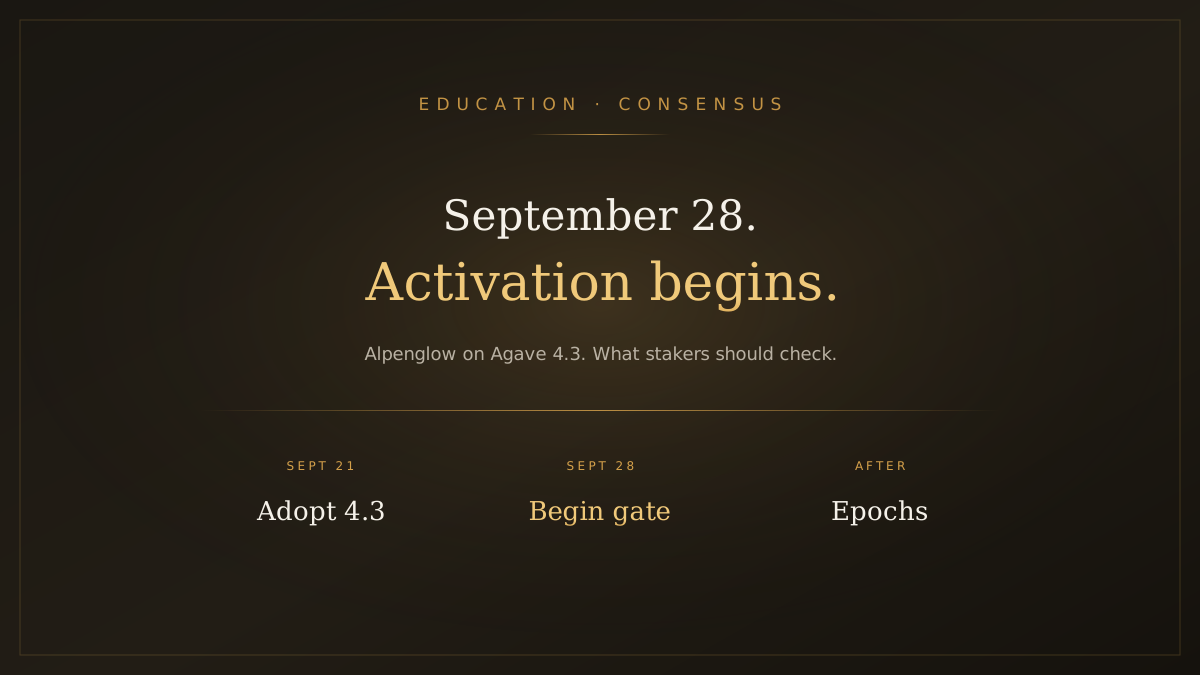
Solana Alpenglow Activation: What Stakers Should Check Before September 28
Alpenglow now has a provisional mainnet runway on Agave 4.3: general adoption September 21, begin feature activation September 28. A short checklist for stakers, not a republish of our earlier explainers.
 Education
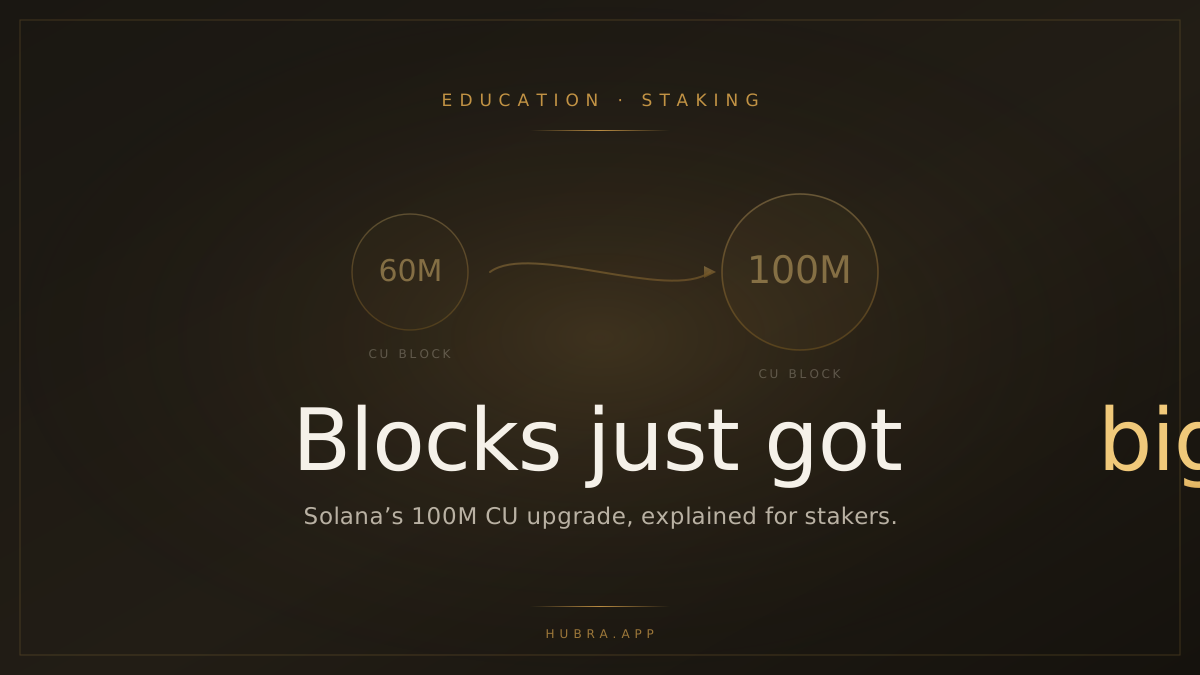
Solana's 100M CU Blocks: What Stakers Need to Know
Solana blocks just got 66% bigger. SIMD-0286 raised the compute limit to 100M CUs on July 29. Here is why more blockspace quietly matters for staking yield.