
Solana Staking APY and SIMD-0550 Disinflation Explained
Solana's staking yield is set by its inflation schedule, and a live governance proposal could cut it sooner than planned. Here is how rewards work and what SIMD-0550 would change for stakers.
TL;DR. Solana staking rewards come mostly from network inflation, which started at 8% and declines toward a 1.5% floor. As of June 2026 the rate is about 3.82%. A live proposal, SIMD-0550, would double the speed of that decline, cutting nominal staking yield faster (roughly 4.34% in year one versus 4.93% today, with a wider gap after). It is not law yet. The direction is set; the debate is about speed.
If you stake SOL, your yield is not a fixed number. It is set by Solana's inflation schedule, and that schedule is under active debate right now. A live governance proposal, SIMD-0550, would cut staking rewards toward their terminal floor years sooner than the current plan.
This guide explains how Solana staking rewards actually work, what SIMD-0550 would change, and what it means for you as a staker. All figures are from the proposal's own projections and Solana's published inflation model.
How Solana staking rewards work
When you stake SOL, you help secure the network and earn rewards in return. Most of that reward comes from inflation: new SOL the protocol issues each epoch and distributes to stakers and validators. A smaller part comes from priority fees and MEV, depending on how you stake.
Solana's inflation is not random. It follows a fixed curve set by three numbers:
- Starting rate: inflation began at 8% per year when it launched in 2021.
- Disinflation rate: that rate falls by 15% every year. So 8% becomes about 6.8%, then about 5.8%, and so on.
- Terminal rate: the decline stops at a 1.5% long-term floor, where it stays permanently.
As of June 2026, the network sits at roughly 3.82% inflation, well down from the original 8% but still several years above the 1.5% floor.
Your actual staking yield is higher than the headline inflation rate because only part of the SOL supply is staked. Rewards are shared among stakers, so a smaller staked percentage means a larger reward per staked SOL. At around 68% staking participation, that works out to a nominal yield in the high-4% range today.
If you want the difference between staking directly and using a liquid staking token, see our guide on what liquid staking is.
What is SIMD-0550?
SIMD-0550 is a Solana governance proposal submitted on June 2, 2026 by Helius engineers lostintime101 and 0xIchigo. It does one thing: it doubles the disinflation rate from 15% to 30% per year.
It does not change where inflation starts (8%) or where it ends (1.5%). It only changes how fast the network travels between those two points. The authors describe it as a single parameter change activated by a permanent feature gate, with no structural change to the issuance curve.
The practical effect is a much shorter timeline to the floor:
| Schedule | Disinflation rate | Time to 1.5% floor | Approx. date |
|---|---|---|---|
| Current | 15% per year | ~5.7 years | H1 2032 |
| SIMD-0550 | 30% per year | ~2.8 years | H1 2029 |
Over a six-year window, total supply would be reduced from about 727.43 million SOL to about 708.54 million SOL. That is roughly 18.9 million SOL of issuance removed, worth about $1.5 billion at current prices.
How SIMD-0550 would change your staking yield
This is the part that matters for stakers. Faster disinflation means rewards shrink sooner. Using the proposal's own projections at 68% staking participation:
| Year | Current schedule | Under SIMD-0550 |
|---|---|---|
| Year 1 | 4.93% | 4.34% |
| Year 2 | 4.17% | 3.00% |
| Year 3 | 3.52% | 2.25% |
The gap is small in year one and grows quickly. By year three, the proposed schedule pays roughly a third less in nominal staking yield than the current path.
There is an important nuance here. Lower nominal yield is not the same as lower real return. Supporters argue that high issuance dilutes every holder, so cutting emissions can leave stakers better off even at a lower headline APY, because less new SOL is being printed against them. Critics counter that lower advertised yields could weaken the incentive to stake and reduce network security at the margin.
What it means for validators
Validators run the infrastructure that earns these rewards, and they feel reduced issuance first. The proposal estimates that out of 738 active validators, about 2 would become unprofitable in year one, rising to 13 in year two and 30 in year three.
The authors frame this as a manageable transition rather than a systemic risk. Their argument is that long-term sustainability requires fee revenue to eventually exceed inflation-based issuance, and that staying on high emissions only delays that adjustment. Smaller validators with thin margins are the most exposed, which is part of why validator operators and broader token holders often land on different sides of this debate.
SIMD-0550 is not the only idea on the table
A competing proposal, SIMD-0547, attacks the same problem from a different angle. Instead of cutting issuance on a schedule, it adds a resource-based fee on transactions that is fully burned, scaling the daily SOL burn with network usage. Estimates put that burn at 16x to 100x current levels during busy periods.
The two are not mutually exclusive. One reduces supply on a predetermined timeline, the other ties supply reduction to real activity. Both are still at the proposal stage with no vote dates announced. This debate also runs alongside Alpenglow, Solana's new consensus upgrade, which reshapes validator economics in a separate way.
Where SIMD-0550 stands now
As of mid-June 2026, the proposal is in community discussion and gaining momentum. On June 10, an Anza reviewer signaled near-approval on the GitHub pull request, one of the two technical sign-offs a SIMD needs before it can advance. Review from the Firedancer team is still pending.
This is the third attempt at the same core idea. An earlier version, SIMD-0228, went to a validator vote in March 2025 and failed. A follow-up, SIMD-0411, was submitted in November 2025 but closed in January 2026 without advancing. SIMD-0550's renewed traction, including public encouragement from Solana co-founder Anatoly Yakovenko to revisit doubling the disinflation rate, marks a real shift from those earlier efforts.
Nothing here is final. The proposal still needs both technical approvals and a validator vote before any change reaches mainnet.
What stakers should do now
You do not need to react to a proposal that has not passed. But it is worth understanding the direction of travel: Solana's staking yield is designed to fall over time, and the live debate is about whether it falls faster.
A few practical takeaways:
- Yield will decline either way. The disinflation curve is already built in. SIMD-0550 changes the speed, not the destination.
- Liquidity matters more as yields compress. When nominal staking yield drops, the flexibility of keeping your assets usable becomes more valuable. That is the core case for liquid staking.
- Look at total return, not just APY. Lower issuance can support the SOL price by reducing dilution, so a lower headline yield is not automatically worse.
- Know your options. Whether you choose native staking for the cleanest custody or a liquid staking token for composability, the underlying reward schedule is the same. Pick for flexibility, not a yield gimmick.
With Hubra, you can stake, track your positions, and move between yield strategies in one place, without juggling multiple apps or paying gas up front.
This article is for educational purposes only and is not financial advice. Staking rewards, proposals, and figures reflect the state of Solana governance as of June 2026 and can change. Always do your own research before staking.
 Education
What You Can Do With raSOL in Solana DeFi
Your staked SOL does not have to sit still. Five ways to put raSOL to work across Solana DeFi, from Kamino loops to Meteora liquidity, and the risks of each.
 Education
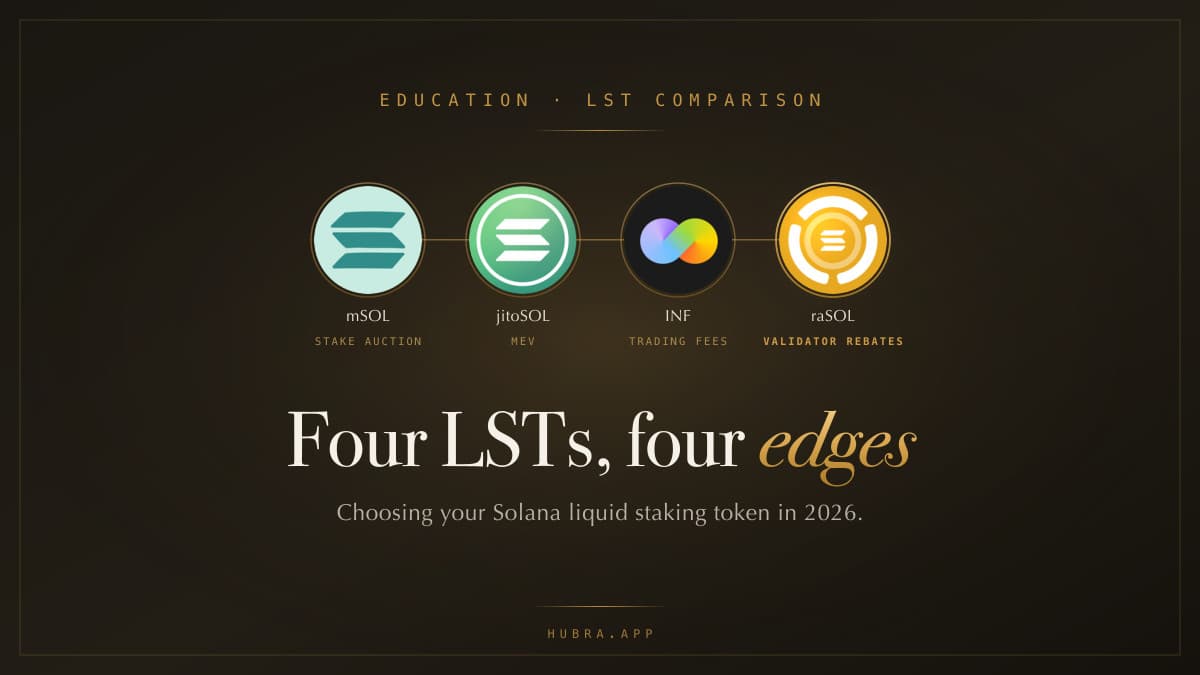
raSOL vs JitoSOL vs mSOL vs INF: Solana LST Compared
JitoSOL leads on liquidity, mSOL on its validator stake auction, INF on diversified fee-boosted yield, and raSOL rebates the earnings of a single long-running validator, with instant exit. Here is how the major Solana LSTs compare in 2026.
 Education
How to Stake SOL in 2026: A Complete, Practical Guide
A plain-English walkthrough of how to stake SOL in 2026: the two main routes, how to pick a validator, what APY to expect, how to exit, and the risks worth knowing, written plainly.