
Solana Alpenglow Countdown: BLS Keys Are Live on Mainnet
Solana's consensus switch moved from plan to mainnet prep this week. BLS keys, a 2,000-validator voting cap, and what Alpenglow means for your staked SOL.
TL;DR. Alpenglow stopped being a roadmap item this week. Validator operators confirmed that SIMD-0387 is active on Solana mainnet, so validators can now register the BLS keys that the new consensus requires - and any vote account without one cannot participate after the switch. Agave v4.1.1 and the first v4.2 beta shipped, Epoch 1000 passed on July 10, and the co-founder's stated target is as early as Q3 2026. Staking rewards are designed to stay flat through the change. Your job as a staker is simpler: make sure your validator is ready.
Solana's biggest consensus change since launch has quietly moved onto mainnet. Not the switch itself - that is still months away - but the plumbing it depends on. This week validator operators confirmed that BLS key registration is live on mainnet, the first concrete Alpenglow requirement that every validator must now complete.
If you stake SOL, this is the point where a distant upgrade becomes something to track. Here is what changed, what still has to happen, and what it means for your stake.
What changed on Solana mainnet this week?
Three things landed in the space of a few days.
BLS key registration went live. According to validator community reports summarized by Chainflow, operators confirmed that SIMD-0387 activated on mainnet in early July. Validators can now register BLS public keys on their vote accounts, and Anza updated its documentation to match. This is the on-chain prerequisite for Alpenglow voting.
New client releases shipped. The official Solana Changelog for July 9 lists Agave v4.1.1 and v4.2.0-beta.0, alongside a new Firedancer mainnet release. Agave 4.1, released June 26, was the version that carried the Alpenglow readiness work: BLS key support, the Validator Admission Ticket mechanism, and faster leader handovers. The 4.2 beta is the first look at the release where activation could plausibly happen.
Epoch 1000 passed. Solana mainnet crossed its thousandth epoch on July 10, a little over six years after mainnet beta launched in March 2020. It landed in a strong stretch for the network: June 2026 set a monthly record of about 3.77 billion non-vote transactions, and weekly non-vote transactions crossed 1 billion for the first time in early July.
None of these changes your balance. Together, they mark the start of the activation runway.
What is a BLS key, and why does Alpenglow need one?
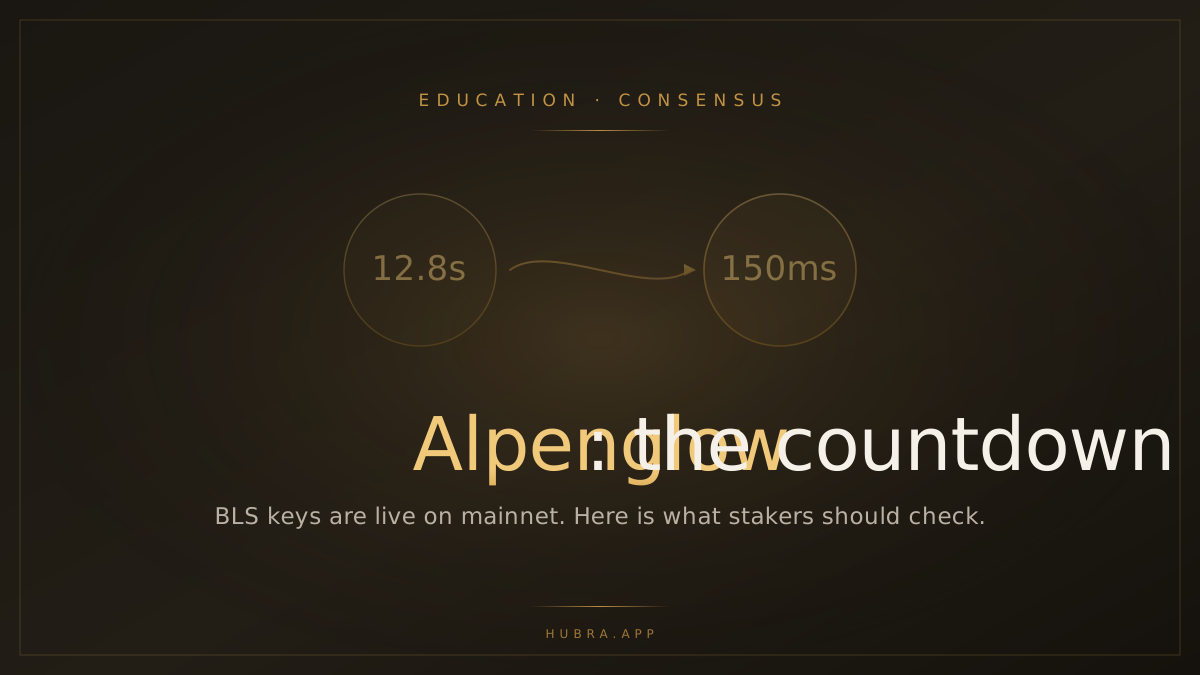
Alpenglow replaces Solana's current consensus (TowerBFT, with Proof of History pacing it) with two new components: Votor, which handles voting, and Rotor, which handles data propagation. The headline result is finality dropping from roughly 12.8 seconds today to around 150 milliseconds.
Votor gets its speed partly from how votes are signed. Today validators sign votes with Ed25519 keys, one signature per vote, and every signature is verified individually. Alpenglow uses BLS aggregate signatures instead, which let thousands of votes be compressed into a compact proof and verified together. That is what makes near-instant finality affordable at Solana's scale.
The practical rule is strict: a vote account with no registered BLS key cannot participate in consensus after Alpenglow activates. The validator's existing Ed25519 vote authority key is not going away - it still controls the account and guards the BLS key - but registration is mandatory for anyone who wants to keep voting. That is why this week's activation matters: the registration window on mainnet is now open.
| Today (TowerBFT) | Under Alpenglow | |
|---|---|---|
| Vote signatures | Ed25519, verified one by one | BLS, aggregated and verified together |
| Finality | ~12.8 seconds | ~150 milliseconds (target) |
| Cost to vote | Vote transaction fees, ~2.1 SOL per epoch | Validator Admission Ticket, 1.6 SOL per epoch, burned |
| Voting set | Uncapped | Capped at 2,000 validators by stake weight |
| Entry requirement | Vote account + fees | Registered BLS key + admission ticket balance |
How close is Alpenglow to mainnet activation?
Closer than most people track, but with real steps left. The record so far:
| Milestone | Status |
|---|---|
| Validator approval vote (SIMD-0326) | Passed September 2, 2025, with 98.27% of participating stake in favor |
| Community test cluster | Running since May 2026 with ~100 validators; Mithril became the fourth client to produce blocks on it in June |
| BLS key registration (SIMD-0387) | Active on mainnet as of early July 2026, per validator reports |
| Validator Admission Ticket (SIMD-0357) | Code shipped in Agave 4.1; not yet activated |
| Agave 4.2 | Targeted for mid-August 2026; Alpenglow activation described as a possibility, not a commitment |
On timing, Solana co-founder Anatoly Yakovenko said at Consensus Miami in May that Alpenglow could reach mainnet as early as Q3 2026 if testing holds. Anza's Max Resnick has framed late Q3 or early Q4 as plausible. Both are targets, not dates. Solana upgrades have a history of staged, cautious rollouts, and a consensus replacement is the most careful change there is.
For the full plain-English breakdown of how Votor, Rotor, and the VAT work, see our Alpenglow explainer.
Does Alpenglow change your staking rewards?
No - and that is deliberate. The Validator Admission Ticket replaces the vote fees validators already pay (roughly 2.1 SOL per epoch) with a slightly cheaper 1.6 SOL per epoch, and that SOL is burned rather than paid to anyone. The design goal, stated in the proposal itself, is to keep validator economics at a similar equilibrium, not to raise or cut staking yield.
The proposals that will actually move your yield are a different set. SIMD-123 block reward sharing routes validator block revenue to stakers in protocol. SIMD-550 disinflation would cut inflation rewards faster. SIMD-553 would burn a resource fee on every transaction. Those are the yield stories; Alpenglow is the speed story.
There is one indirect way consensus changes touch your rewards: validator operations. This month's cautionary tale came from the Jito client, where roughly 48 validators running version 4.1.0 or 4.1.0-rc.1 were reported to be earning no Jito tips until the 4.1.1 fix, according to validator community reports. For their delegators, that was a real dent in MEV yield for as long as it lasted. As the client release cadence speeds up ahead of Alpenglow, a validator's ability to keep its software current is quietly becoming a yield factor.
What stakers should do now
Check your validator's readiness. The two questions that matter: is it running a current client version, and has it registered a BLS key? Validator dashboards have started surfacing this - operators discussed BLS warnings appearing on Stakewiz this week. A validator that never registers cannot vote after activation, and a non-voting validator earns nothing for its stakers.
Native stakers: your delegation choice is the lever. Nothing about your stake account changes, but readiness now belongs on the same checklist as commission and performance when you pick a validator. If you want a refresher on how delegation and epochs work under the hood, see staking mechanics or start with native staking.
Liquid stakers: your pool handles it, but it is worth knowing. Stake pools and LST operators manage validator sets professionally, and routing stake toward ready validators is exactly the kind of thing they are paid to do. If you are weighing the two approaches, our liquid staking guide and liquid staking page cover the tradeoffs.
Expect no action required at the switch. When activation comes, it will arrive as a feature gate at an epoch boundary, the same way Solana ships every major change. Balances, delegations, and rewards carry through. The upgrade is designed so that the only thing stakers should notice is the chain getting faster.
Watch August. Agave 4.2 is the release to follow. It is slated to make the new networking stack the default and begin the slot-time reduction toward 200ms, and it is the earliest window anyone credible has attached to Alpenglow activation. If the timeline slips, that tells you something too.
The quiet part of this week is the most important: Solana started asking validators to prove they are ready. For stakers, the checklist is short, but it is no longer empty.
This article is for information only and is not financial advice.
 Education
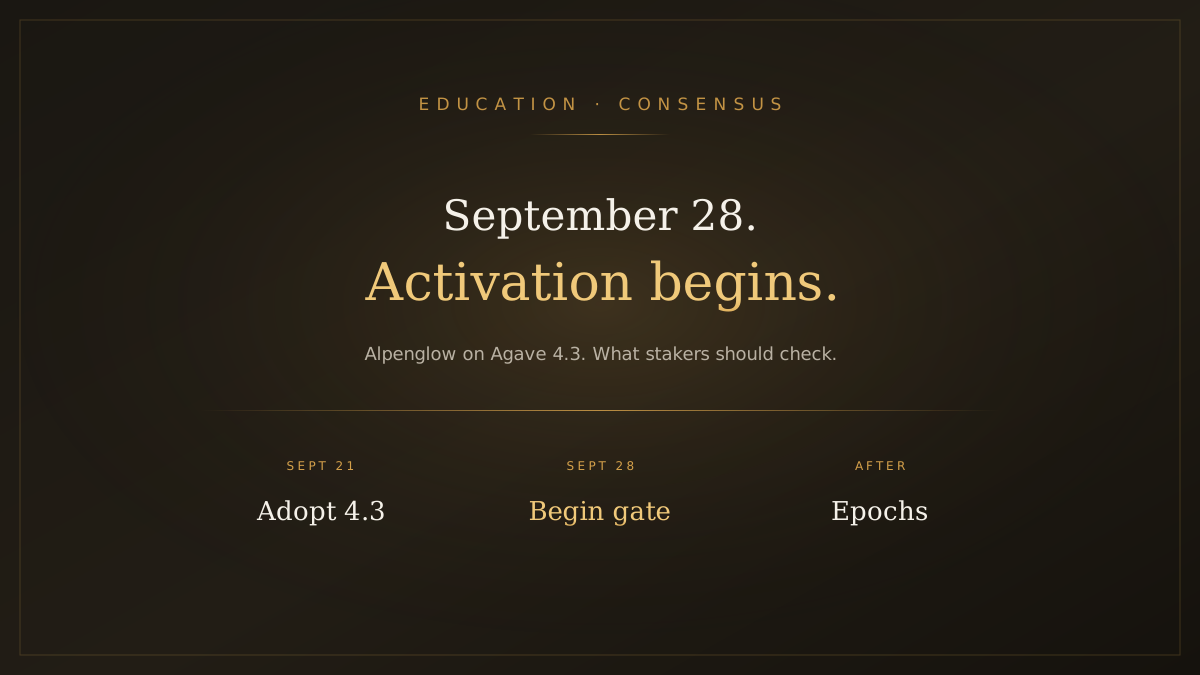
Solana Alpenglow Activation: What Stakers Should Check Before September 28
Alpenglow now has a provisional mainnet runway on Agave 4.3: general adoption September 21, begin feature activation September 28. A short checklist for stakers, not a republish of our earlier explainers.
 Education
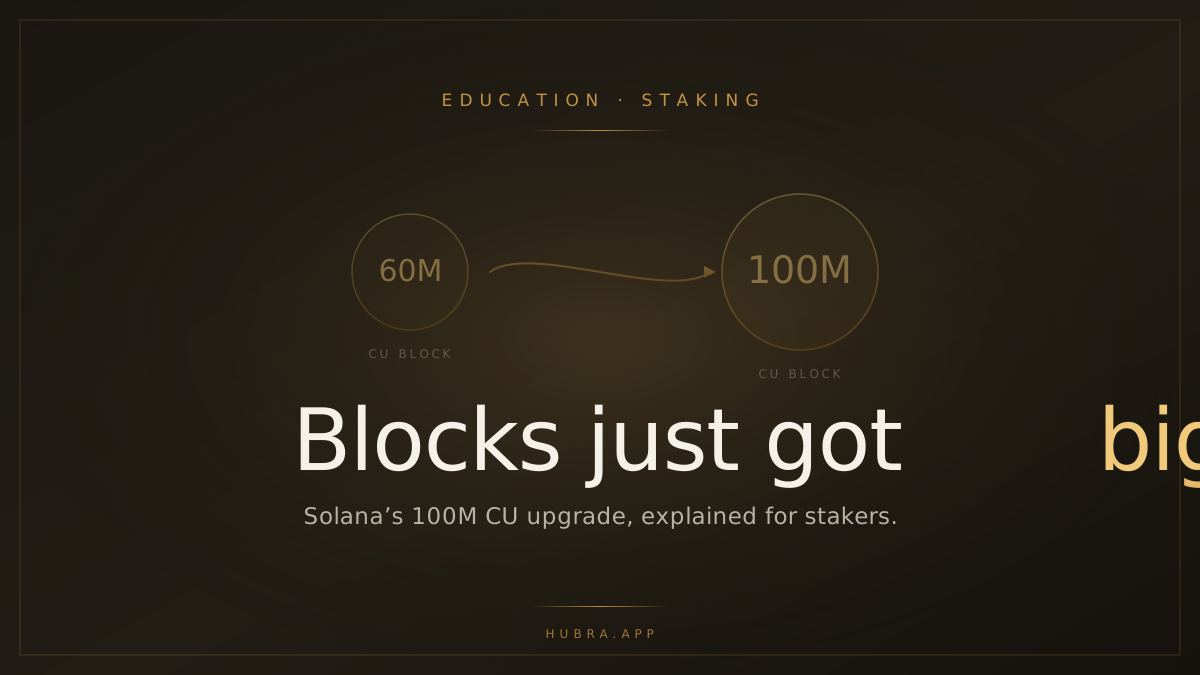
Solana's 100M CU Blocks: What Stakers Need to Know
Solana blocks just got 66% bigger. SIMD-0286 raised the compute limit to 100M CUs on July 29. Here is why more blockspace quietly matters for staking yield.
 Education
What You Can Do With raSOL in Solana DeFi
Your staked SOL does not have to sit still. Five ways to put raSOL to work across Solana DeFi, from Kamino loops to Meteora liquidity, and the risks of each.