
Solana's First Governance Vote: What SGP-0001, 0002, and 0003 Mean for Stakers
Three proposals. Two passed. One failed. Solana's first on-chain governance vote set the rules, sped up disinflation, and left fee burns for another day. Here is the staker briefing.
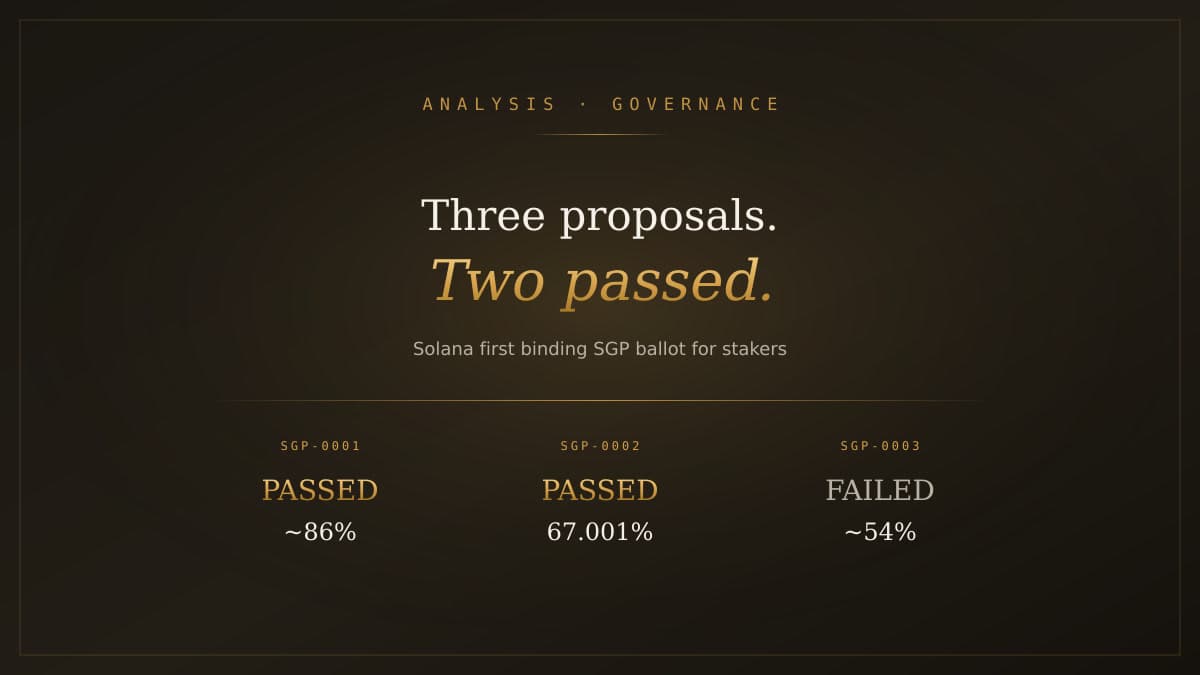
TL;DR. Solana's first binding SGP ballot ran across epochs 1021 to 1024, opening around August 23 UTC and closing at the end of epoch 1024 on August 28, 2026. Three independent votes, three independent outcomes: SGP-0001 ratified the Constitution; SGP-0002 approved faster disinflation by 0.334 percentage points; SGP-0003's fee burn failed. All three cleared quorum. Nothing on mainnet flipped overnight. SGP-0002 is a vote for SIMD-0550, not a live APR cut, and SGP-0003's burns never activated. If you stake SOL, the story is the APY path SGP-0002 sets once the gate turns on, and the LST override that tipped a close vote.
For years, Solana stakers watched validators vote on their behalf. In June 2026, on-chain governance went live and stake became a ballot. Six weeks later, the network ran its first binding SGP ballot: three proposals in one voting window, each judged on its own tally, all meeting quorum, closing at the end of epoch 1024.
Here is what each proposal did, how it scored, and what it means if you stake natively or hold a liquid staking token.
What was Solana's first governance vote?
Voting opened with epoch 1021 around August 23 UTC and closed at the end of epoch 1024 on August 28, 2026.
| Proposal | Subject | Result | Headline tally |
|---|---|---|---|
| SGP-0001 | Solana Constitution | Passed | 86.0% For, 193.65M for / 4.63M against; ~52% participation (Decrypt); 85.97% / 51.96% participation (SolanaFloor) |
| SGP-0002 | Double disinflation (SIMD-0550) | Passed | 67.001% For (+0.334 pts); 176.29M for / 66.19M against / 20.63M abstain; 60.7% of 433.49M eligible; 1,326 validators |
| SGP-0003 | Resource and inclusion fee (SIMD-0553) | Failed | 53.9% For, 142.84M for / 50.15M against / 72.03M abstain |
Every proposal cleared the one-third stake quorum. SGP-0001 and SGP-0002 also cleared the two-thirds supermajority among For, Against, and Abstain. SGP-0003 fell short on its own tally, with abstention doing much of the damage. Three ballots, three independent outcomes.
What did SGP-0001 do? (Solana Constitution)
Before economics, the network ratified the rulebook.
SGP-0001 sets how future SGP ballots work: one-third of stake must participate for quorum; two-thirds of For plus Against plus Abstain must vote For to pass; Abstain counts for quorum but not for For; and stakers can override their validator's vote (including LST holders on pools that support override).
The vote was decisive. Decrypt reports 86.0% For, with 193.65 million SOL for versus 4.63 million against and roughly 52% participation. SolanaFloor independently cites 85.97% For with 51.96% participation.
That matters beyond ceremony. Every economic fight that follows (faster disinflation, fee burns, whatever comes next) runs on these thresholds. If you have not read how override works, our governance and staker voting guide is the place to start.
What did SGP-0002 change? (Double disinflation)
This was the economic headline of the ballot.
SGP-0002 is a vote to activate SIMD-0550, which would double the annual disinflation rate from 15% to 30% once the feature gate turns on. Modeling attached to the proposal projects roughly 18.9 million fewer SOL issued over six years and a 1.5% terminal inflation floor around 2029 instead of roughly 2032. The terminal rate itself does not change. Only the speed to get there does. That faster path is not live on mainnet.
The vote was close enough to remember:
| Metric | Value |
|---|---|
| Result | Passed |
| Vote share (For) | 67.001% |
| Supermajority threshold | 66.667% |
| Margin | +0.334 percentage points |
| SOL for | 176.29M |
| SOL against | 66.19M |
| SOL abstain | 20.63M |
| Eligible stake | 433.49M SOL |
| Participation | 60.7% |
| Validators voting | 1,326 |
Solana Compass reported that JitoSOL holders' staker override was decisive in the closing hours. That is the Hubra-relevant governance story on this ballot. LST delegators are not silent bystanders when override is enabled.
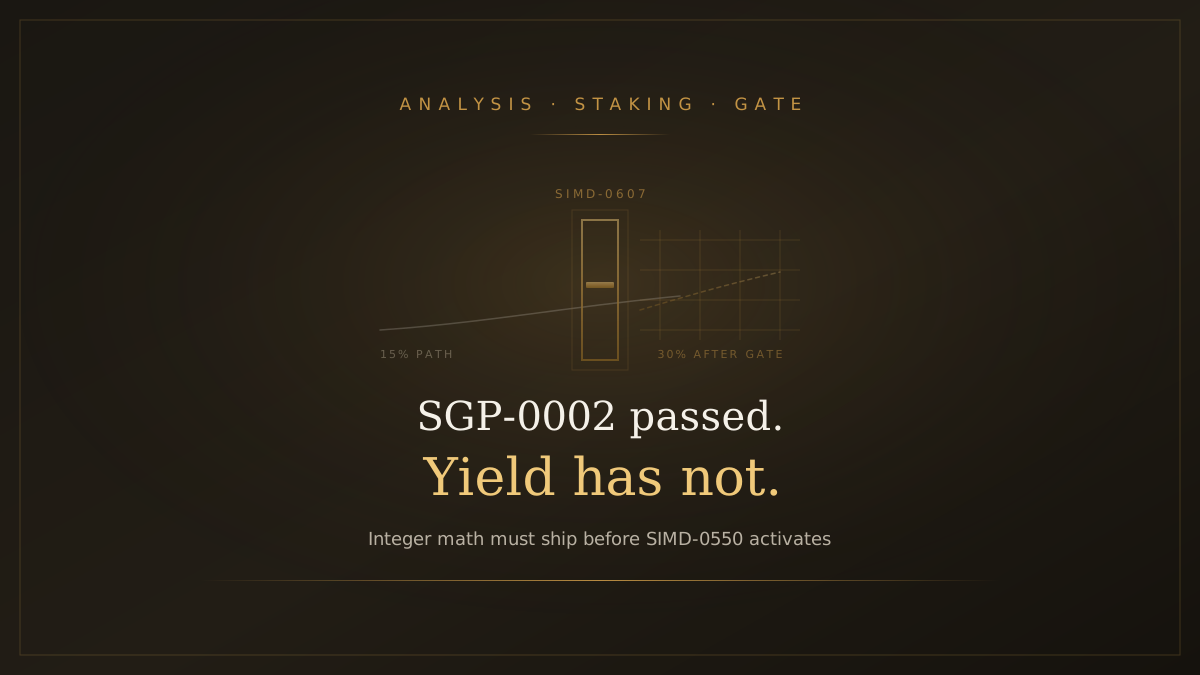
What has to happen before your APR moves: SGP-0002 passed, but activation follows a chain. SIMD-0607 (deterministic inflation reward math) clears review, Agave v4.4 ships with Firedancer alignment, and validators schedule the SIMD-0550 feature gate at an epoch boundary. Until that gate flips, epoch rewards follow the existing 15% disinflation schedule. For the projected APY path once activation arrives, see our staking rewards and disinflation guide.
Why did SGP-0003 fail? (Fee burn proposal)
The fee-burn proposal did not clear the bar.
SGP-0003 would have replaced the flat 5,000-lamport per-signature fee with a ~2,500-lamport inclusion fee to the block leader plus a variable resource fee (compute-unit-based) burned 100%. CoinDesk figures relayed by Solana Compass projected that, if the proposal had passed, daily burns could have risen from roughly 650 SOL to about 7,500 to 9,000 SOL, still well below the roughly 60,000 SOL/day the network mints through inflation. It did not pass. No new burn is live.
It failed with 53.9% For, 142.84M SOL for, 50.15M against, and 72.03M abstain. With abstention counting toward quorum but not toward For, the two-thirds bar stayed out of reach.
Opposition came from apps and staking operators named in KuCoin and HTX coverage, including Jupiter, Drift, Forward Industries, Anagram Staking, and Solana Company. The concern, in broad terms: a usage-scaled burn shifts cost toward heavy transaction senders and changes validator fee economics in ways many operators were not ready to accept on the first ballot.
For stakers today: the fee structure is unchanged. Flat per-signature fees continue as before. Reporting suggests the idea may return in revised form. Anatoly Yakovenko has publicly suggested splitting the proposal rather than abandoning fee reform entirely.
What does this mean for native stakers?
The rules are set. SGP-0001 passed cleanly. Future votes run on the Constitution's quorum and supermajority math, and you can override your validator when you disagree.
Your APY path has a new direction, not a new rate. SGP-0002 gives the network permission to accelerate disinflation once the SIMD-0550 gate activates. It does not cut your next epoch payout. Budget on the current schedule until gate activation is published. Then revisit the projected path in our disinflation explainer.
Fees are unchanged. SGP-0003's failure means no resource fee burn is live. Priority fees and the existing flat base fee still drive what validators earn from transactions.
Your vote mattered. This ballot proved staker override is not theoretical. If your validator voted differently from how you would have, the override exists for the next fight.
What does this mean for LST holders?
Mechanically, LSTs earn the same underlying inflation rewards as native stake. When the SIMD-0550 gate eventually activates (not before), JitoSOL, mSOL, and other major LSTs move with the same inflation curve. There is no separate yield schedule for liquid positions, and nothing has changed yet.
The governance layer is the Hubra angle on this ballot. Solana Compass credited JitoSOL staker override with tipping SGP-0002 into passage by 0.334 points. Pool operators cast the default vote. Delegators who overrode carried the margin. That is a governance story with direct consequences for the APY path once SIMD-0550 goes live.
Do not rotate LSTs solely because SGP-0002 passed or SGP-0003 failed. Do know how your pool handles governance: default operator vote, override availability, and public statements on the next ballot. Our governance guide walks through who controls the vote for native versus pooled stake.
What should stakers watch next?
- SIMD-0607, then Agave v4.4, then the feature gate for SGP-0002. The passed vote is direction. The activation chain is the calendar. Until the SIMD-0550 gate is scheduled, yields stay on the pre-vote path.
- A possible fee-burn return. SGP-0003 failed and no burn is live, but the debate is not over. Watch for a split or revised SIMD if builders and stakers renegotiate the burn component.
- The next SGP. The Constitution is ratified, the first economic vote passed, and stakers proved they can swing a close vote. The next ballot will run on the same rules, with your stake as the weight.
This article is for information only and is not financial advice. Vote tallies and projections are cited from Decrypt, SolanaFloor, Solana Compass, HTX, KuCoin, and CoinDesk reporting as noted in the text.
 Analysis
Why Solana Staking Yields Have Not Changed After SGP-0002
SGP-0002 passed by 0.334 points. Your next epoch payout did not move. Faster disinflation is gated on SIMD-0607, client releases, and a feature gate with no public activation date.
 Analysis
Why Our Validator Voted Yes on Solana's New Economics
We operate a validator. The proposals on Solana's first governance ballot cut our income directly. We voted yes on both, and this is the honest reasoning.
 Analysis
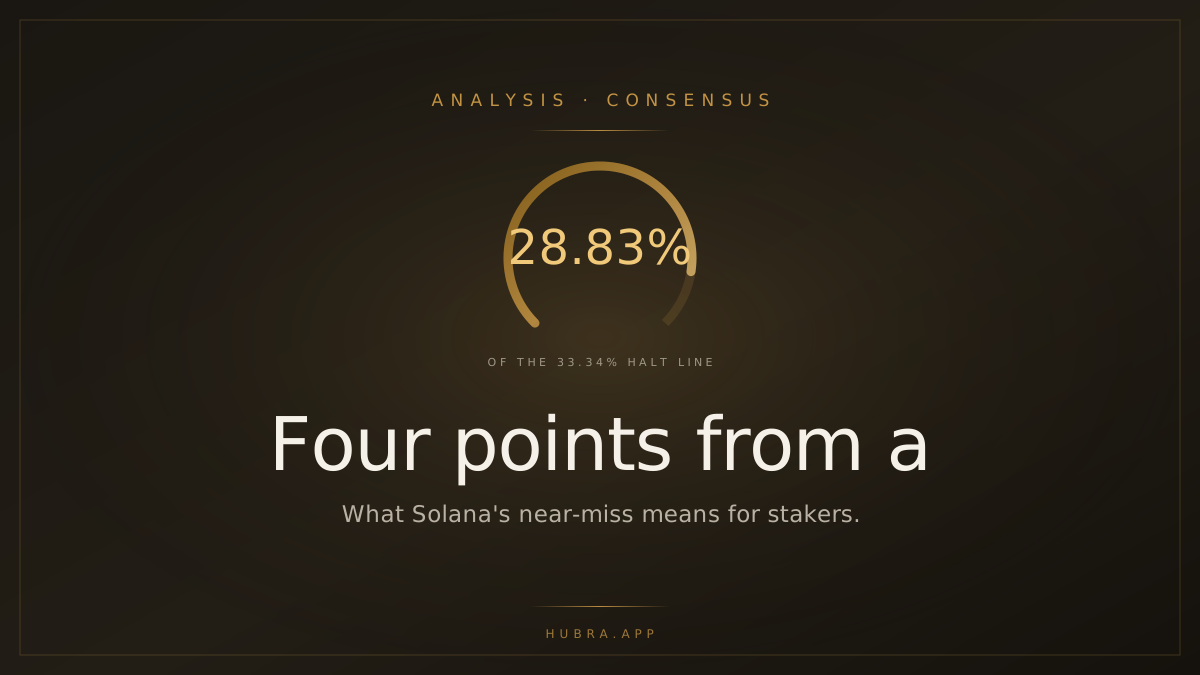
Solana Validator Concentration Risk After the Near-Halt
One infrastructure failure pushed nearly 29% of Solana stake offline. Finality needs more than two thirds of stake voting. Here is what stakers should check now.