
Why Our Validator Voted Yes on Solana's New Economics
We operate a validator. The proposals on Solana's first governance ballot cut our income directly. We voted yes on both, and this is the honest reasoning.
TL;DR. Solana's first on-chain governance vote closes with epoch 1023 on August 27. Two of the three proposals, faster disinflation (SGP-0002) and a resource-based fee burn (SGP-0003), directly reduce validator revenue. We run a validator, and we voted yes on both. The short version: high inflation was the right subsidy when Solana needed to buy its builder ecosystem, and that purchase already succeeded. A mature network with real usage should stop diluting the holders and let them share the upside. That logic costs us money, and we think it is still correct.
Hubra operates a Solana validator. When we voted on Solana's first governance ballot this week, we voted yes on the two proposals that cut our own income. This article is the reasoning, written plainly, including the part where it hurts.
If you want the mechanics of the proposals, our explainer on the burn and disinflation vote covers them in detail. This piece is about the judgment call.
What was on the ballot
Voting opened with epoch 1021 on August 23 and runs to the end of epoch 1023, around 15:30 UTC on August 27. A proposal needs roughly one third of active stake to participate and a two-thirds supermajority of decisive votes to pass.
| Proposal | What it does | Cost to validators |
|---|---|---|
| SGP-0001 | Ratifies the Solana Constitution | None |
| SGP-0002 | Doubles disinflation from 15% to 30% per year | Staking rewards shrink years sooner |
| SGP-0003 | Burns a dynamic fee based on resources consumed | Modeled ~4% income reduction |
SGP-0002 does not change where Solana ends up. The terminal inflation rate stays at 1.5%. It changes when: roughly 2.8 years instead of 5.7. Along the way, modeling attached to the proposal estimates about 19 million SOL that will never be minted, around 2.6% of projected supply.
SGP-0003 rebuilds part of the fee itself. Today every transaction pays a flat 5,000 lamports per signature, half burned, half to the validator. The proposal makes the burn component dynamic, priced on what a transaction actually consumes: compute units, write locks, signatures, loaded account data, instruction data. Third-party estimates suggest daily burns could rise from roughly 650 SOL to several thousand, though the exact parameters were still being debated through the discussion period.
Inflation was a salary, and it did its job
Here is the frame we keep coming back to. A new chain has nothing: no apps, no liquidity, no users worth building for. The only thing it can pay with is its own token, and the people it needs to pay are not users. They are builders, operators, and teams who have to choose Solana over every other place they could spend their careers. High inflation and a low burn on usage is exactly that: a payroll, funded by diluting holders, spent on making the network attractive to the people who create growth.
That was the right trade in 2020 and it was still defensible in 2023. It is not the situation in 2026. Solana today has one of the deepest application ecosystems in crypto, real fee revenue, institutional products, and a consensus upgrade pipeline that ships. Competition among builders is fierce. Bringing something new to Solana and earning a place in it takes perhaps ten times the investment it took three years ago. That is not a complaint; it is what winning looks like. The subsidy bought the ecosystem it was supposed to buy.
When the payroll has done its job, you stop paying it at the old rate. Continuing peak-subsidy issuance into a mature network means diluting every holder to overpay for growth that now happens on its own.
The early-investor logic
Think of holding SOL the way you would think of backing a company early. In the early stage, spending is heavy and income is thin, and nobody involved expects dividends; the money goes to hiring and product because that is what compounds. Once the company matures and revenue arrives, the calculus flips. Investors of every size, not just the large ones, are supposed to enjoy the fruits.
SGP-0002 and SGP-0003 are, together, that flip. Faster disinflation slows the dilution of every holder. A resource-based burn ties SOL's supply directly to network usage, so activity itself becomes the payout mechanism. Neither proposal hands anyone a check. What they do is move value capture from the subsidized side of the network to the holding and using side. For the person who staked SOL through the loud years, that is the point of having held.
This is also, frankly, what institutional capital needs to see. A supply schedule that tightens on a credible timetable and a fee model that burns with usage are legible to people who model cash flows for a living. The proposals read like a network graduating from a growth story to an earnings story.
The part that costs us
Now the honest part. As a validator, voting yes here is voting against our own revenue. Staking commission shrinks with inflation. The dynamic burn trims fee income. Modeling around SGP-0002 suggests roughly 30 validators could go from profitable or break-even to unprofitable within about three years, and the squeeze lands on small independent operators first, because delegators facing lower yields will demand a bigger share of whatever revenue remains.
We will not pretend otherwise: the direction of travel pushes small validators like ours toward full depreciation, and the network needs a serious conversation about what validator economics should look like after disinflation. That conversation deserves its own article, and we intend to write it. The concentration risk we covered after the August near-halt is part of the same thread: a network secured by fewer, larger operators is a real cost, not a rounding error.
The strongest technical objection raised in validator discussions is about security. If yield falls faster, some stake will leave for DeFi, and stake participation is a variable that consensus actually depends on. Nobody has firmly answered how much participation Solana can lose before it matters. We take that seriously. We also note that the terminal rate is unchanged, stakers can vote and override validators directly if the balance tips wrong, and governance that just proved it can change economics once can change them again.
Weighing all of it, we think the greater good is not close. A tighter supply schedule, a usage-linked burn, and a ratified constitution move Solana up a level, toward the kind of network that institutions allocate to and users trust with size. Our margin is a fair price for that.
What stakers should do now
Know that your yield trajectory changed. If SGP-0002 passes, staking APY declines faster than the old schedule, reaching the same 1.5% floor around three years sooner. Our disinflation breakdown has the projections. Yield does not disappear; the path steepens.
Judge validators by what comes next. As inflation yield compresses, fee revenue and how validators share it become the differentiator. Watch how your validator performed through this vote and what it says about block reward sharing.
Use your own vote. Stakers can vote directly and override their validator. This ballot will not be the last, and the override exists precisely so that operators like us do not get the final word on your economics.
Keep the long view. If you hold SOL, these proposals were written for you. Staking through the transition, natively or liquid, keeps you earning while the supply curve tightens underneath your position.
We cast our yes votes knowing what they cost us. A network that has earned its maturity should pay its holders, not its payroll.
This article reflects our own views as a validator operator, is for education only, and is not financial advice.
 Analysis
Why Solana Staking Yields Have Not Changed After SGP-0002
SGP-0002 passed by 0.334 points. Your next epoch payout did not move. Faster disinflation is gated on SIMD-0607, client releases, and a feature gate with no public activation date.
 Analysis
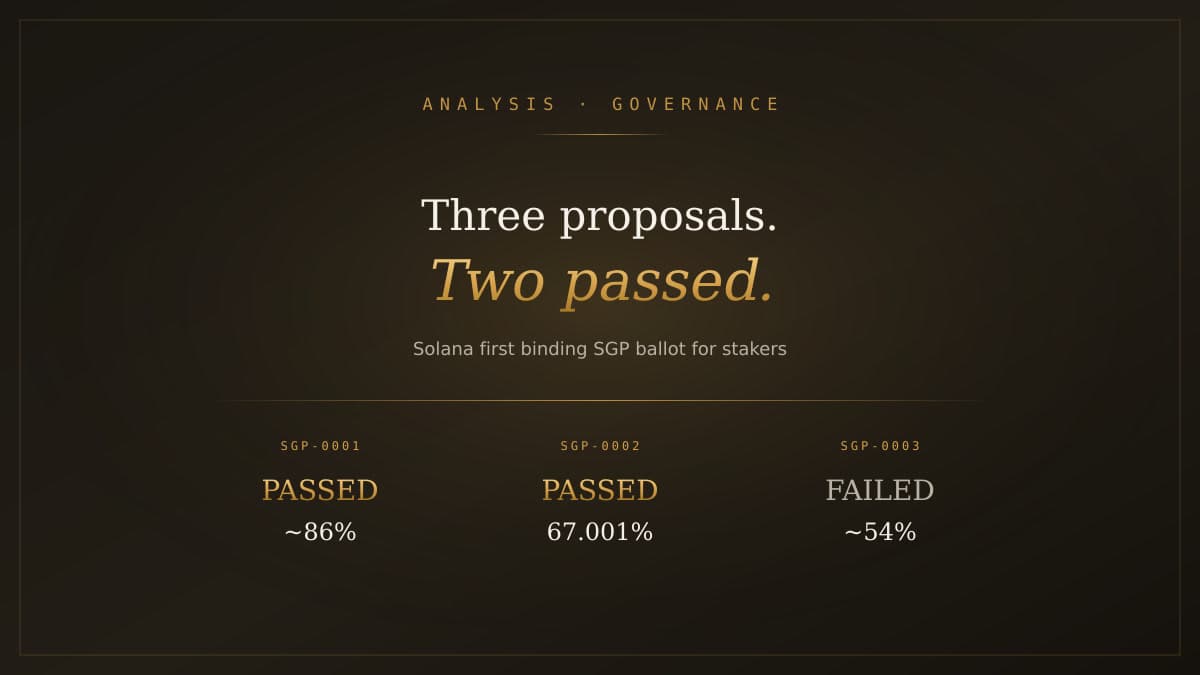
Solana's First Governance Vote: What SGP-0001, 0002, and 0003 Mean for Stakers
Three proposals. Two passed. One failed. Solana's first on-chain governance vote set the rules, sped up disinflation, and left fee burns for another day. Here is the staker briefing.
 Analysis
Alpenglow: Solana's new consensus, in plain English
Alpenglow is the biggest change to Solana since the chain went live. Confirmations that feel instant, a calmer chain under the hood, and a new validator fee called the VAT that's designed to keep economics flat, not to raise your staking yield. Here's what it means in plain English.